
KEY TAKEAWAYS
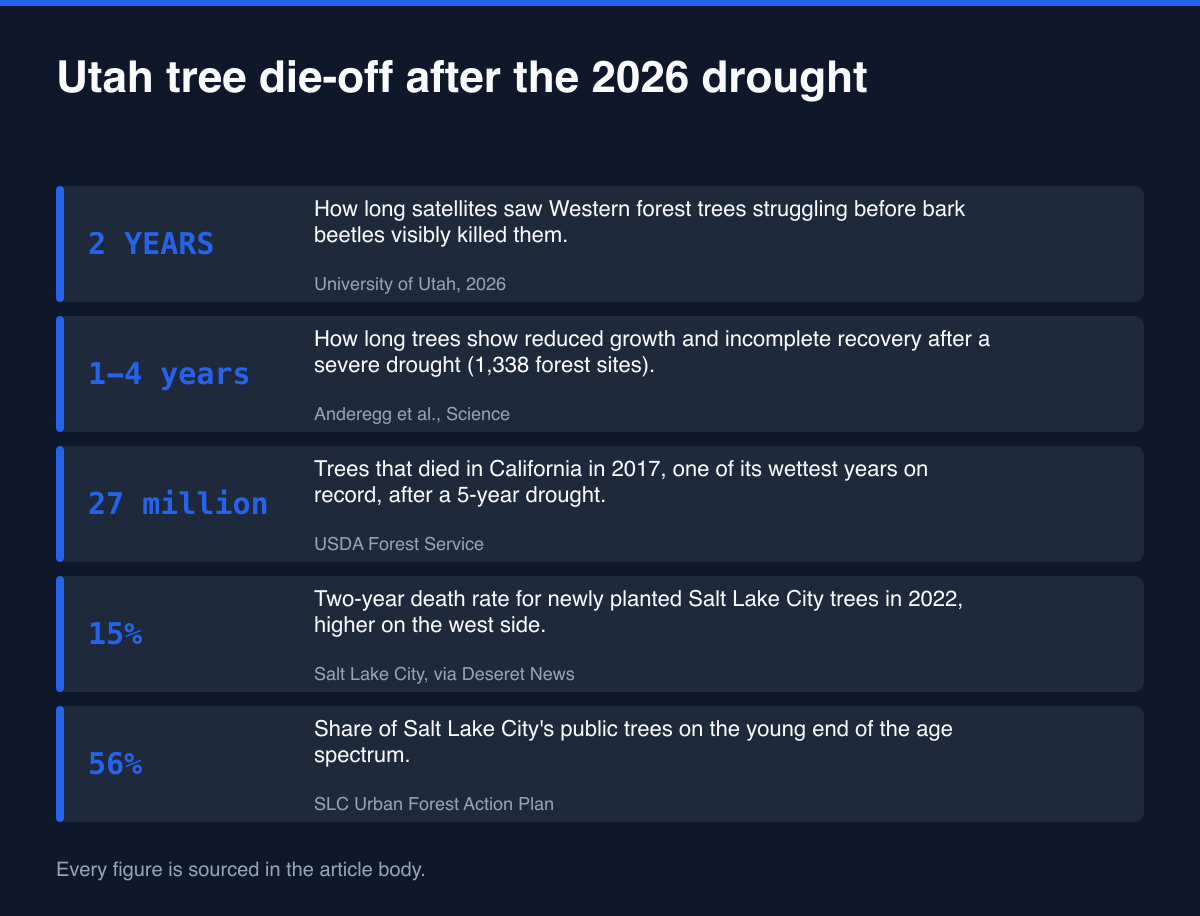
- → 1 to 4 years Trees showed reduced growth and incomplete recovery for 1 to 4 years after severe drought across 1,338 forest sites worldwide. (Anderegg et al., Science, 2015)
- → 27 million California mapped 27 million newly dead trees in 2017, its 5th-wettest water year on record, with mortality attributed primarily to the preceding 5-year drought. (California Forest Pest Council / USDA Forest Service, 2017)
- → 15% Salt Lake City reported a 15% two-year mortality rate for newly planted trees citywide in 2022, higher on the hotter west side. (Deseret News, 2022)
- → 56% 56% of Salt Lake City’s public trees are on the younger end of the age spectrum and need adequate care and water to reach maturity. (Salt Lake City Urban Forest Action Plan, 2020)
- → 54% Utah’s reservoirs averaged 54% full in August 2026, 13% below normal and 16% below the same time last year. (National Weather Service Salt Lake City, 2026)
- → 16,500 Bark-beetle damage in Utah’s forests reached 16,500 damage acres in 2023, a better water year that followed three hot, dry years, before falling to 4,700 in 2024. (USDA Forest Service / Utah FFSL, 2023)
If you own a home, manage an HOA or look after a commercial property anywhere in the Salt Lake Valley, you have probably noticed it this fall: leaves browning at the edges, maples and aspens dropping early, evergreens looking thin. Utah just came through its warmest winter on record and record-low snowpack, and reservoirs sat at 54% of capacity in August (National Weather Service Salt Lake City, 2026). It is natural to look at a stressed tree and wonder whether it is about to die.
Here is the good news, and the catch. Most established trees will not die this year. Drought damage works on a delay: research across forest sites worldwide found trees kept struggling for 1 to 4 years after a severe drought (Anderegg et al., Science, 2015), and new University of Utah research found satellites could see Western forest trees struggling two years before bark beetles visibly killed them (University of Utah (via Newswise), 2026). That means the trees you lose to this drought, if you lose any, are more likely to go in 2027 or 2028, often after everyone has stopped watering because the rain came back.
That delay is your window. Below, we pulled together the numbers that answer the questions property owners actually ask: how bad this drought is, how long the damage takes to show, which trees are most at risk (young trees planted in the last few years top the list) and how much water it takes to carry a tree through. Every figure links to its original source, so you can check it yourself or share it with your HOA board or property manager.
1 How Bad Is Utah’s 2026 Drought for Trees?
Severe to extreme drought covered most of Utah in August 2026. Reservoirs averaged 54% full, they began drawing down 13% between May and July against a typical 1%, and 10% of streams ran at all-time record low flows (National Weather Service Salt Lake City, 2026). For trees, that means a second hard drought in five years.
| METRIC | VALUE | SOURCE |
|---|---|---|
| Utah reservoir storage, August 2026 | 54% | National Weather Service Salt Lake City |
| Reservoir drawdown, May–July 2026 | 13% | National Weather Service Salt Lake City |
| Typical May–July drawdown | 1% | National Weather Service Salt Lake City |
| Streams at all-time record low flows | 10% | National Weather Service Salt Lake City |
| Streams at near or above normal flows | 25% | National Weather Service Salt Lake City |
| Utah winter 2025–26 temperature rank | warmest on record | KUER |
| Recent Utah tree-ring drought marker years | 2002, 2018, 2022 | Utah State University |
| Rise in Salt Lake City autumn overnight lows, 1970–2023 | 4.8 degrees | KUER |
Only 25% of the state’s creeks, streams and rivers were running at near or above normal levels in August, according to the National Weather Service’s drought statement (National Weather Service Salt Lake City, 2026). In Emery County, cities cut water and irrigation companies severely reduced allocations. For a yard tree, that is the real exposure: rain was always scarce here, and what keeps Salt Lake Valley trees alive is irrigation. When the water supply tightens, landscape trees are often the first thing people stop watering.
The tree-ring record shows how unusual this pattern has become. Utah State University dendrochronologist Justin DeRose notes that drought marker years, the narrow rings left by very dry years, used to come decades apart. Recent ones fell in 2002, 2018, 2022, with 2026 likely next (Utah State University, 2026). A tree that never fully recovered from 2022 started this year already drawn down. Heat adds to the strain: Salt Lake City’s autumn overnight lows have risen 4.8 degrees since 1970 (KUER, 2026), so trees get less relief at night.
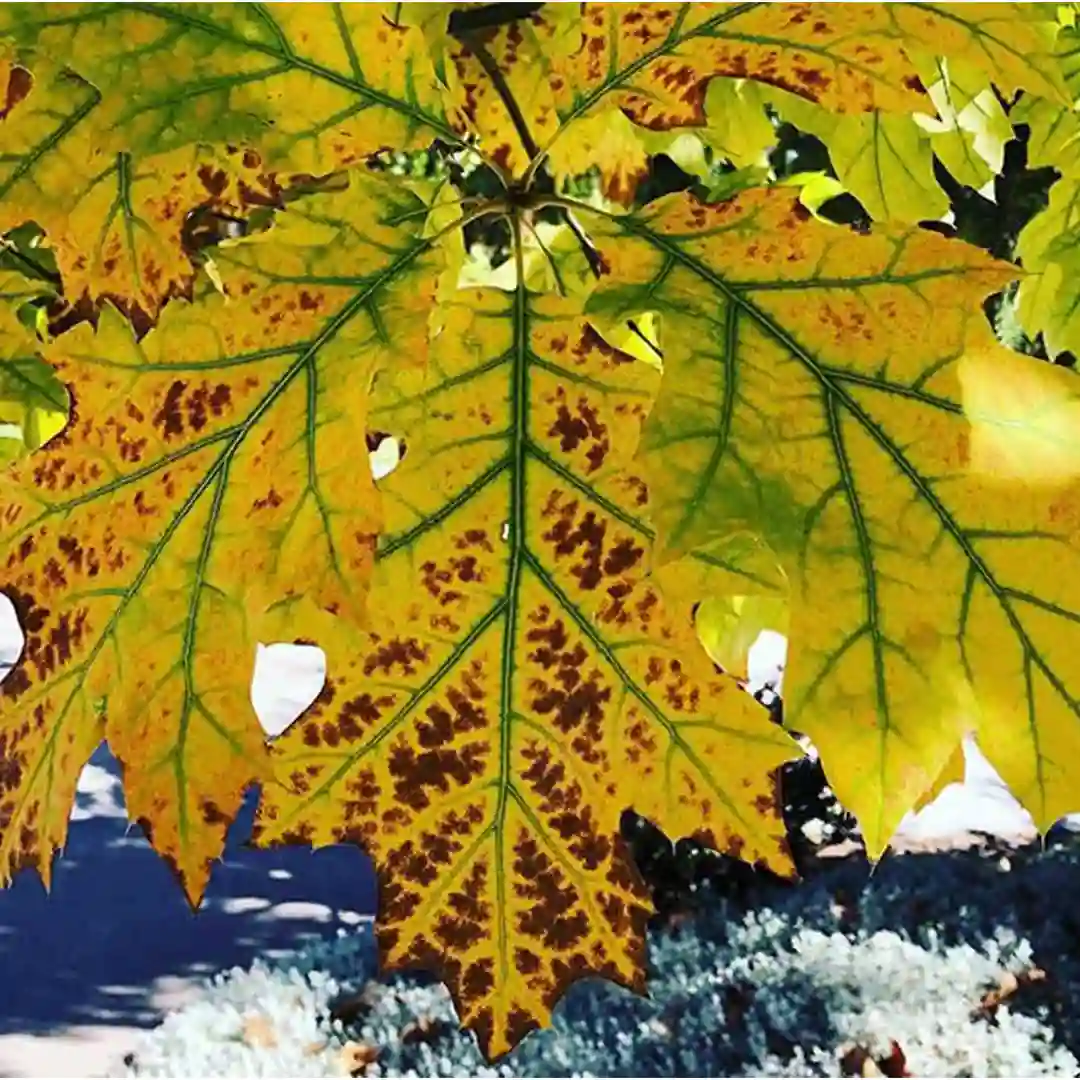
The first symptoms are already visible. Maples and aspens around the valley showed leaves browning from the edges in during summer heat waves, and early leaf drop costs trees nutrients they need going into winter. Those are the early warning signs of tree stress worth noting now, because they mark which trees to watch over the next two seasons.
2 Do Trees Die the Same Year as a Drought? California Lost 27 Million the Year After
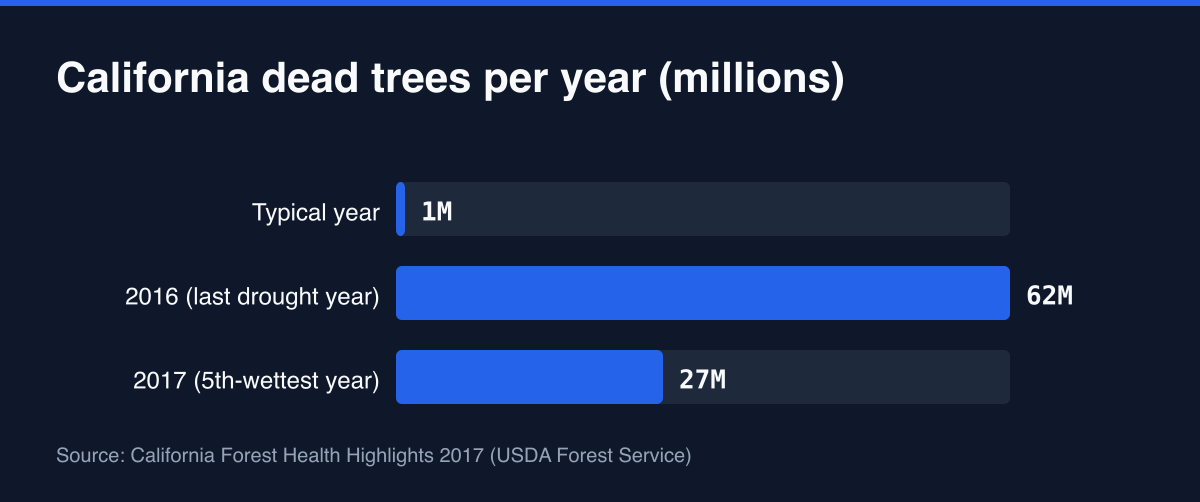
Usually not. Across 1338 forest sites worldwide, trees showed reduced growth and incomplete recovery for 1 to 4 years after severe drought (Anderegg et al., Science, 2015). California mapped 27 million newly dead trees in 2017, during one of its wettest years on record, compared with roughly 1 million in a typical year (California Forest Pest Council / USDA Forest Service, 2017).
| METRIC | VALUE | SOURCE |
|---|---|---|
| Years of reduced growth after severe drought | 1 to 4 years | Anderegg et al., Science |
| Forest sites in the global drought-legacy study | 1338 | Anderegg et al., Science |
| California dead trees, 2016 (final drought year) | 62 million | California Forest Pest Council / USDA Forest Service |
| California dead trees, 2017 (post-drought wet year) | 27 million | California Forest Pest Council / USDA Forest Service |
| California typical annual tree mortality | 1 million | California Forest Pest Council / USDA Forest Service |
| California April 1, 2017 snowpack, percent of average | 164% | California Forest Pest Council / USDA Forest Service |
The study behind the delay figure, published in Science, compared real tree growth after drought with what climate models assumed. The models expected trees to bounce back right away. The trees did not. These legacy effects were strongest in dry ecosystems and in the pine family (Anderegg et al., Science, 2015), which describes much of the Wasatch Front’s evergreen planting. A pine or spruce that looks fine in October can still be running on empty the next summer.
California shows the pattern at scale. The state recorded 62 million dead trees in 2016, the last year of a five-year drought. The next winter brought a snowpack of 164% of average, and mortality still hit 27 million, which the Forest Service and California Forest Pest Council attributed primarily to the drought that had just ended (California Forest Pest Council / USDA Forest Service, 2017). Weakened trees could not defend themselves against bark beetles, and the beetles did the killing after the rain came back.
For a homeowner, the lesson is about timing rather than panic. One dry summer rarely kills a healthy mature tree outright. University of Utah biologist Eleinis Ávila-Lovera told KUER that a single year of stress is not likely to kill a mature tree, comparing repeated drought to drawing on a savings account that is not refilled. The trees to worry about are the ones already showing signs of dying going into next spring.
3 Did Utah’s Forests Follow the Same Delay After the Last Drought?
Yes. Bark-beetle damage in Utah reached 16,500 damage acres in 2023, a better water year that followed three hot, dry ones, then dropped to 4,700 in 2024 (USDA Forest Service / Utah FFSL, 2024). Total insect, disease and weather damage fell from 27,900 to 17,800 damage acres over the same two years.
| METRIC | VALUE | SOURCE |
|---|---|---|
| Utah bark-beetle damage acres, 2023 | 16,500 | USDA Forest Service / Utah FFSL |
| Utah bark-beetle damage acres, 2024 | 4,700 | USDA Forest Service / Utah FFSL |
| Utah total forest damage acres, 2023 | 27,900 | USDA Forest Service / Utah FFSL |
| Utah total forest damage acres, 2024 | 17,800 | USDA Forest Service / Utah FFSL |
| Lead time: satellite stress signal to visible die-off | 2 YEARS | University of Utah (via Newswise) |
| How much less photosynthesis fell in forests that survived | 10-20% | University of Utah (via Newswise) |
The Utah Forest Health Highlights report, compiled by the USDA Forest Service and the state Division of Forestry, Fire and State Lands, says the dry years before 2023 were when damage agents were driving up tree mortality, and that the state’s insect and disease problems are often the result of poor forest health brought on by hot, dry conditions (USDA Forest Service / Utah FFSL, 2024). The heavy beetle kill showed up after the drought years, not during them. These are wildland figures, not yard trees, but the biology is the same: drought weakens the tree’s defenses and something else finishes it off.
New research from the University of Utah puts a number on the warning period. Using satellite measurements of photosynthesis, the team found forest stress was detectable about two years before bark-beetle mortality appeared in aerial surveys. Forests that faced similar drought but survived showed declines 10-20% less severe than the stands that later died (University of Utah (via Newswise), 2026). The stress is measurable long before the brown needles appear.
Bark beetles, borers and fungal cankers are the usual finishing agents in the valley too, which is why the Utah tree pests that matter most after a drought are the ones that target stressed hosts. Evergreens are where most homeowners first see it, as browning that starts inside the canopy or at the top; our guide to evergreen trees turning brown covers what each pattern usually means.
4 What Share of City Trees Die in a Normal Year?
In published urban-forest studies, planted tree groups lose a median 4.4 to 6.5% a year, while mixed-age city tree populations lose 2.3 to 2.6% (Hilbert et al., Arboriculture & Urban Forestry, 2019). Street trees survive at 94.9 to 96.5% a year, giving a population half-life of 13 to 20 years (Roman & Scatena (University of Pennsylvania), 2011). Deaths cluster in the first five years after planting.
| METRIC | VALUE | SOURCE |
|---|---|---|
| Median annual mortality, planted tree cohorts | 4.4 to 6.5% | Hilbert et al., Arboriculture & Urban Forestry |
| Median annual mortality, mixed-age tree inventories | 2.3 to 2.6% | Hilbert et al., Arboriculture & Urban Forestry |
| Typical annual street-tree mortality | 3.5 to 5.1% | Hilbert et al., Arboriculture & Urban Forestry |
| Street tree annual survival rate | 94.9 to 96.5% | Roman & Scatena (University of Pennsylvania) |
| Street tree population half-life | 13 to 20 years | Roman & Scatena (University of Pennsylvania) |
These baselines come from a literature review in Arboriculture & Urban Forestry that pooled decades of tree-survival studies (Hilbert et al., Arboriculture & Urban Forestry, 2019), and from an earlier meta-analysis of street trees by researchers at the University of Pennsylvania. An earlier review put typical street-tree mortality at 3.5 to 5.1% a year (Hilbert et al., Arboriculture & Urban Forestry, 2019). Put simply, even in an ordinary year, a city loses a few trees in every hundred, and far more of the young ones than the old.
That baseline is what a drought pushes up. The same review found the factors most often tied to urban tree death were species, tree size and age, site conditions and, on the human side, stewardship and maintenance. It also noted that irrigation can let trees survive conditions that would otherwise kill them. In the Salt Lake Valley, where almost every tree was planted and lives on supplemental water, irrigation is not a nice extra. It is the difference between the normal death rate and a much higher one.
The half-life figure is a useful reality check. If half of a street-tree population is gone in under two decades in normal conditions, a tree that has made it past thirty years has already beaten the odds. Those large, established trees are worth a professional risk assessment before deciding anything after a hard summer, because they are both the most valuable and the slowest to show drought damage.
5 Why the Trees Planted Since 2021 Are the Ones Most Likely to Die After 2026
Salt Lake City reported a 15% two-year death rate for newly planted trees in 2022, higher on the hotter west side (Deseret News, 2022). The city now plants more than 2,000 trees a year, and 56% of its public trees are on the young end of the age range (Salt Lake City Urban Forest Action Plan, 2020). Recent plantings carry most of the risk.
| METRIC | VALUE | SOURCE |
|---|---|---|
| Two-year mortality, new SLC trees, 2022 | 15% | Deseret News |
| Publicly owned trees in Salt Lake City | 86,500 | Salt Lake City Urban Forest Action Plan |
| Share of public trees on the young end | 56% | Salt Lake City Urban Forest Action Plan |
| Public trees 8 inches DBH or smaller | 41% | Salt Lake City Urban Forest Action Plan |
| Public trees larger than 24 inches DBH | 12% | Salt Lake City Urban Forest Action Plan |
| Trees planted per year, 2024 | 2,000 | Deseret News |
| Trees planted per year, 2014 | 500 | Deseret News |
| Share of public trees in the maple genus | 19.9% | Salt Lake City Urban Forest Action Plan |
| Citywide canopy cover including private land | 15% | Salt Lake City Urban Forest Action Plan |
Salt Lake City’s public forest numbers roughly 86,500 trees, and 41% of them measure eight inches in trunk diameter or less, against just 12% over twenty-four inches (Salt Lake City Urban Forest Action Plan, 2020). Planting has ramped up from fewer than 500 trees a year in 2014 to more than 2,000 a year, as reported by the Deseret News (Deseret News, 2024). That is a good long-term investment, but it means a large share of the city’s trees were planted in the last five years, exactly the establishment window when the research shows death rates run highest.
The city’s own Urban Forest Action Plan names the problem: contractors often do not water during the establishment period, and residents move or stop watering, which leads to excessive rates of new tree mortality (Salt Lake City Urban Forest Action Plan, 2020). The 2022 figure was reported by the Deseret News from city officials and is labelled secondary here; it is the most recent published survival rate for the city. Losses ran higher on the west side, which already has less than half the canopy of east-side neighborhoods.
Species mix adds risk. Maples make up 19.9% of Salt Lake City’s public trees (Salt Lake City Urban Forest Action Plan, 2020), right at the guideline ceiling for one genus, and Norway maple alone exceeds the single-species guideline. Maples were among the trees showing leaf scorch this summer. If you planted a tree since 2021, or your park strip holds one of the city’s newer street trees, that is the tree to prioritize. Our tree planting crews see the same pattern on private lots: young trees rarely die of the drought itself; they die of the watering that stopped.
6 How Much Water Does a Tree Need to Get Through 2027?
Salt Lake City Urban Forestry recommends 5–10 gallons of water per inch of trunk diameter, soaked 18–24 inches deep, with 2–4 inches of mulch (Salt Lake City Urban Forestry, 2026). New trees need water 2–3 times per week in summer. USU Extension says established trees need a deep soak to 18 inches at least twice a month (Utah State University Extension, 2021).
| METRIC | VALUE | SOURCE |
|---|---|---|
| Water per inch of trunk diameter, per watering | 5–10 gallons | Salt Lake City Urban Forestry |
| Depth water should reach | 18–24 inches | Salt Lake City Urban Forestry |
| Summer watering, newly planted trees | 2–3 times per week | Salt Lake City Urban Forestry |
| Established trees: deep soak at least twice monthly to | 18 inches | Utah State University Extension |
| Mulch depth around the base | 2–4 inches | Salt Lake City Urban Forestry |
The delay is an opportunity. If drought deaths peak a year or more after the dry season, then the watering done this fall, through next summer and into 2027 decides a large part of the outcome. Deep, infrequent soaking matters more than frequent light watering, because lawn sprinklers wet the top few inches while tree roots need water at 18–24 inches (Salt Lake City Urban Forestry, 2026). Our guide on how often to water trees in summer breaks the schedule down by tree age and soil type.
Two habits do most of the work. First, keep watering through the first wet spell after a drought, which is exactly when California’s die-off kept going and when homeowners are most likely to stop. Second, put down a layer of mulch over the root zone rather than up against the trunk, to slow evaporation and keep soil temperatures down. USU Extension horticulturists reported that after the last severe drought ended they saw a wide range of trees and shrubs with pest and disease problems, particularly pines and spruces.
For trees already showing thin crowns, dead branch tips or scorched foliage, the window to act is now rather than after the leaves are gone. A plant health care visit can check for borers and root stress before the next growing season, and saving a dying tree is far more realistic in its first year of decline than its third. If you are unsure what you are looking at, start with our guide to diagnosing tree problems in Utah.
Explore every figure in this article
Methodology
We started from the questions homeowners ask most often about drought and dying trees, then gathered only figures we could trace to a source we opened. Those include the National Weather Service’s August 2026 Utah drought statement, the USDA Forest Service’s Utah and California Forest Health Highlights, Salt Lake City’s Urban Forest Action Plan and watering guidance, peer-reviewed reviews of urban tree mortality, the Science study on drought legacy effects and University of Utah research published in September 2026. Every source URL was fetched and each figure checked against the page. The forest health reports, the urban forest plan and the urban mortality review are PDFs our verifier cannot parse; we read each one directly and confirmed every value. The Science abstract blocks automated access, so its figures were confirmed through Europe PMC. Salt Lake City’s 2022 new-tree mortality rate and its planting counts come from Deseret News reporting of city figures and are labelled secondary. No agency tracks deaths of private yard trees in Utah, so this page uses public-tree records, published urban studies and wildland aerial surveys; forest damage acres describe mapped wildland damage, and California’s 2016–2017 losses are an analogue, not a Utah forecast. Research stages that ran in reduced form: the competitor backlink format filter found no competitor with an editorial link profile, so it did not inform the format choice; two of fifteen search-result checks failed after retries; and the first recency sweep failed for lack of API credits and was re-run in full after the account was topped up.
- Sources consulted: 34
- Sources cited: 14
- Data freshness: current year: 6, last year: 0, older: 8
- Data range: 2011-01-01 to 2026-09-30
- Research date: 2026-09-30
- Update schedule: Annually, after the Utah Forest Health Highlights and Salt Lake City urban forestry reports
- Limitations: No agency tracks deaths of private yard trees in Utah, so mortality rates come from Salt Lake City’s public-tree program, published urban-forest studies and wildland aerial surveys. Forest damage acres measure mapped wildland damage, not urban trees. California’s 2016-17 figures are an analogue from another state, not a Utah forecast.
Frequently Asked Questions
Will the 2026 drought kill my trees this year?
Probably not this year. Most established trees survive the dry summer itself, and the damage shows up later. A global study of 1,338 forest sites found reduced growth and incomplete recovery for 1 to 4 years after severe drought. The years to watch in the Salt Lake Valley are 2027 and 2028, especially for trees that go unwatered once the drought eases. (Anderegg et al., Science, 2015)
Why do trees die after the drought is over?
A drought drains a tree’s reserves and damages its water-conducting tissue, and bark beetles and diseases finish off weakened trees later. California mapped 27 million newly dead trees in 2017, one of its wettest years on record, and the U.S. Forest Service attributed the deaths primarily to the five-year drought that had just ended. (California Forest Pest Council / USDA Forest Service, 2017)
How many newly planted trees die in Salt Lake City?
Salt Lake City reported a 15% two-year mortality rate for newly planted trees citywide in 2022, a drought year, with higher losses on the hotter west side. The city’s urban forest plan blames insufficient or ineffective watering during the establishment period, not the trees themselves. (Deseret News, 2022)
What is a normal tree death rate in a city?
Across published studies, the median annual mortality for planted tree cohorts is 4.4 to 6.5%, compared with 2.3 to 2.6% for mixed-age tree populations. Deaths are concentrated in the first five years after planting, which is why young trees need the most attention in and after a drought. (Hilbert et al., Arboriculture & Urban Forestry, 2019)
How much should I water a tree during a Utah drought?
Salt Lake City Urban Forestry recommends 5–10 gallons of water per inch of trunk diameter each watering, soaked 18–24 inches deep, with 2–4 inches of mulch to slow evaporation. Newly planted trees need water 2–3 times per week in summer. USU Extension says established trees need a deep soak at least twice a month. (Salt Lake City Urban Forestry, 2026)
How bad is Utah’s drought in 2026?
Severe to extreme drought covered most of Utah in August 2026, according to the National Weather Service. Reservoirs averaged 54% full, 13% below normal, and 10% of streams were at all-time record low flows after the state’s warmest winter on record and record-low snowpack. (National Weather Service Salt Lake City, 2026)
Sources & References
- University of Utah (via Newswise). “Satellites Spot Forest Stress Two Years Before Bark Beetle Die-Offs Become Apparent.” newswise.com/articles/satellites-spot-forest-stress-two-years-before-bark-beetle. Accessed 2026-09-30.
- Anderegg et al., Science. “Pervasive drought legacies in forest ecosystems and their implications for carbon cycle models.” doi.org/10.1126/science.aab1833. Accessed 2026-09-30.
- California Forest Pest Council / USDA Forest Service. “2017 California Forest Health Highlights.” fs.usda.gov/media/237512. Accessed 2026-09-30.
- Deseret News. “Why Salt Lake City plants thousands of new trees every year.” deseret.com/utah/2024/04/26/why-salt-lake-city-plants-thousands-of-new-trees-eve. Accessed 2026-09-30.
- Salt Lake City Urban Forest Action Plan. “Salt Lake City Urban Forest Action Plan, Chapter 2: Urban Forest Analysis.” slcdocs.com/Planning/Projects/Urban%20Forest%20Action%20Plan/PDF%20Chapters/Chap. Accessed 2026-09-30.
- National Weather Service Salt Lake City. “Drought Information Statement for Utah and Uinta County, WY (valid August 12, 2026).” weather.gov/media/slc/DGT/DGT_SLC_08132026.txt. Accessed 2026-09-30.
- USDA Forest Service / Utah FFSL. “Utah Forest Health Highlights 2024.” fs.usda.gov/foresthealth/docs/fhh/UT_FHH_2024.pdf. Accessed 2026-09-30.
- KUER. “Utah’s historic snow drought is one that trees will likely never forget.” kuer.org/science-environment/2026-03-27/utahs-historic-snow-drought-is-one-that-. Accessed 2026-09-30.
- KUER. “Utah’s increasingly dry, warm weather could mess with leaf peepers’ fall colors.” kuer.org/science-environment/2026-09-24/utah-climate-warm-weather-drought-stress. Accessed 2026-09-30.
- Utah State University. “This Year’s Snow Drought is Etching Itself Into Utah Forest History.” usu.edu/today/story/this-years-snow-drought-is-etching-itself-into-utah-forest-h. Accessed 2026-09-30.
- Hilbert et al., Arboriculture & Urban Forestry. “Urban Tree Mortality: A Literature Review.” fs.usda.gov/nrs/pubs/jrnl/2019/nrs_2019_hilbert_001.pdf. Accessed 2026-09-30.
- Roman & Scatena (University of Pennsylvania). “Street tree survival rates: Meta-analysis of previous studies and application to a field survey in Philadelphia.” earth.sas.upenn.edu/content/street-tree-survival-rates-meta-analysis-previous-st. Accessed 2026-09-30.
- Salt Lake City Urban Forestry. “How to Water a Tree.” slc.gov/urban-forestry/how-to-water-a-tree/. Accessed 2026-09-30.
- Utah State University Extension. “Ask an Expert: With Proper Care, Drought Won’t Permanently Damage Yards.” extension.usu.edu/news_sections/gardening/with-proper-care-drought-wont-permanen. Accessed 2026-09-30.
- Maple Tree Leaf courtesy of Utah State University
Last updated:

