Tree Planting

Tree Planting on the Wasatch Front: What We’ve Learned From Doing It For Over 50 Years

Spring and fall. That’s when you plant. Not because it’s a rule someone made up, it’s because the tree actually has a chance to survive those windows. 

Soil is workable, temps aren’t punishing, and the root system gets time to settle in before something extreme happens. We’re in Utah. Something extreme always happens eventually.

Fall gets underestimated. People see leaves dropping and assume the tree has shut down for the year. It hasn’t. 

Root growth continues after the canopy goes dormant, sometimes well into November depending on soil temps. A tree planted in September can push a surprising amount of root development before January. That’s a real head start on the following spring.

Summer planting isn’t impossible but it’s a bad bet. We’ve seen it work. We’ve seen it fail more. 

A tree that just got pulled from a container is already stressed. Putting it in the ground in July, in full sun, in the kind of clay-heavy alkaline soil you’ll find across most of the Salt Lake Valley , that’s a rough combination. 

You can compensate with aggressive watering but you’re fighting the situation rather than working with it.

What are Best Types of Trees to Plant in Northern Utah?

Nurseries are full of beautiful trees that have no business being planted in Utah. That’s not a criticism of nurseries, it’s just the reality of how plants get marketed and sold. Something that thrives in Oregon or the mid-Atlantic can really struggle here. Different water, different soil chemistry, different seasonal swings.

Get your free ESTIMATE

Contact Us

Give Us a Call:  (801) 262-1596

Diamond Tree Experts recommends native and adapted species for a reason. Gambel oak is the example we come back to a lot. It’s drought tolerant once it gets going, it handles clay, it supports local wildlife, and it looks good for decades with minimal intervention. Not exciting at the nursery, maybe. But in twenty years you’re not calling us to figure out why it’s dying.

Bigtooth maple is another one. Great fall color, lower water demand than the ornamental maples that get imported from wetter climates. Serviceberry works well in tighter spaces, it stays manageable, handles dry summers, and produces berries that birds actually eat.

Before you pick a tree, figure out what the site is. How much sun. What the soil is actually like (dig down a foot and look at it.) 

How close to structures or utility lines the tree will eventually reach. 

We’ve removed a lot of trees over the years that were planted by people who didn’t think about the mature size. The tag at purchase says “medium tree.” Medium can mean 50 feet. That matters when it’s 12 feet from a house.

plant-health-care


Tree Planting Tips

Digging the Hole

Wide, not deep. That’s the whole instruction, and most people do the opposite.

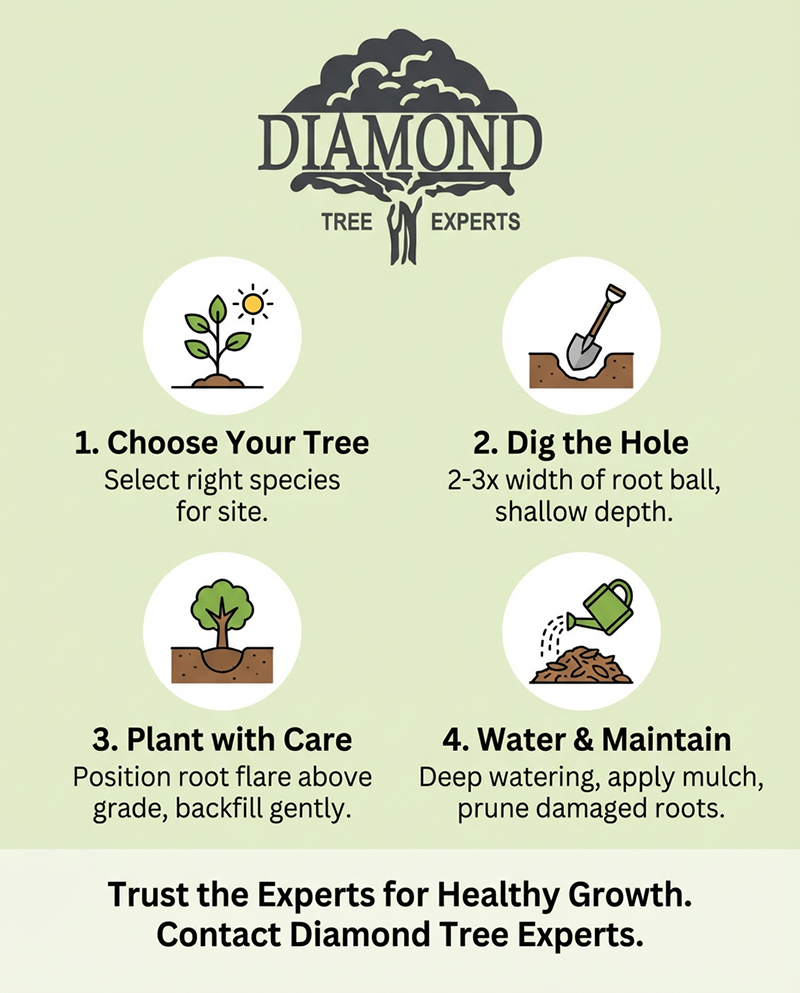
The hole should be two to three times the width of the root ball. Depth should match the root ball exactly, not more. What you’re doing is giving the lateral roots room to spread. Trees root outward, not downward. A narrow, deep hole works against how the tree actually wants to grow.

Planting too deep is the mistake we see most often. The tree looks fine for a year or two. Then it starts declining slowly and nobody can figure out why. By the time the canopy shows real distress the root system is already compromised. Buried root flares are the culprit more often than people realize.

The root flare is where the trunk widens at the base. It should sit at ground level or just above it when you’re done. If it ends up buried under three inches of soil, moisture collects against the bark continuously. Decay moves in. Insects find it. The tree loses years off its life.

Pull the tree out of the container before you set it and actually look at the roots. Circling roots are common in containerized stock, the roots hit the container wall and start wrapping around. 

Left alone, they keep circling as the tree grows. In bad cases they’ll eventually girdle the trunk, cutting off the flow of water and nutrients. Score the outside of the root ball, straighten what you can, cut the ones that are badly circled. Takes five minutes and matters a lot.

Backfill with your native soil. The amended backfill advice (mixing in compost, adding special soil mixes) has mostly been walked back by arborists over the past couple decades. 

The thinking now is that roots need to adapt to what’s actually there, not a comfortable pocket they’ll never want to leave. Use what came out of the hole.

Tree Removal Services

large tree removal

Tree Removal

tree trimming

Tree Trimming

stump grinding

Stump Grinding

mulch

Mulch Products

green waste dumping

Green Waste Dumping

demolition

Demolition

watering-tree

Tree Watering Practices

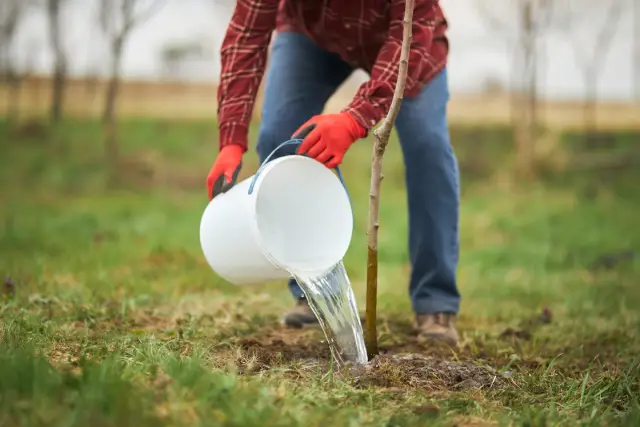
More trees die from watering problems than from anything else. Not disease. Not pests. Water: either too inconsistent, too shallow, or not enough during the establishment window.

Deep and infrequent beats shallow and frequent. You want moisture getting down to the root zone, not just wetting the top two inches. A soaker hose laid in a ring around the drip line, left to run slowly, does this better than hand watering. Drip emitters work. Tree watering bags work. Whatever gets water in at a slow enough rate that it actually percolates down.

In a Utah summer, watering once or twice a week is reasonable. Clay soils hold moisture longer than sandy ones. 

Check below the surface before you water again six inches down, feel if it’s still damp. If yes, wait. Water stressed trees show it in the morning. Midday wilt in July heat is normal. Morning wilt means the tree doesn’t have enough water.

Keep this going for two full growing seasons. After that, a tree that’s well-established and regionally adapted should handle normal Utah conditions with occasional supplemental watering during extended dry spells.

Add Mulch, But Do It Smartly

Add three to four inches of wood chip mulch extending out to the drip line. It holds moisture, moderates soil temp, and cuts down on grass and weeds competing with the roots. Simple and effective.

Keep it away from the trunk. An inch or two of clearance at the base so bark can stay dry. 

Mulch piled against the trunk stays wet and creates conditions for decay and pests. Volcano mulching (that cone-shaped pile you see everywhere) is wrong. It’s everywhere and it’s wrong. Pull it back.

Staking

Skip it if you can. A tree that moves slightly in wind builds stronger trunk tissue than one held rigid. There’s actual research behind this. If the tree stands on its own, let it stand on its own.

If it needs support, use two stakes placed outside the root ball and attach with something soft and flexible. Leave slack so the tree still moves. 

Remove stakes after the first growing season.  Leaving them longer actually weakens trunk development rather than helping it.

Tree Planting Big Picture

A tree planted correctly in the right location, with decent water through its first two summers, is largely going to take care of itself. 

That’s the whole point of choosing regionally adapted species and getting the planting right from the start, you’re not setting yourself up for decades of intervention.

We’ve been working with trees across Salt Lake, Davis, Utah, and Weber counties since 1967. The trees we see failing are almost always traceable to something that happened in the first year. Wrong species, wrong depth, not enough water, staked too long. The trees that are thriving forty years later were planted well once and left alone.

If you have questions about species selection, soil conditions on your specific property, or whether a tree you’re considering makes sense for where you want to put it, we’re glad to talk it through. 

Our Service Area

salt lake city

Salt Lake City

draper

Draper

sandy

Sandy

ogden utah

Ogden

layton

Layton

riverton

Riverton