
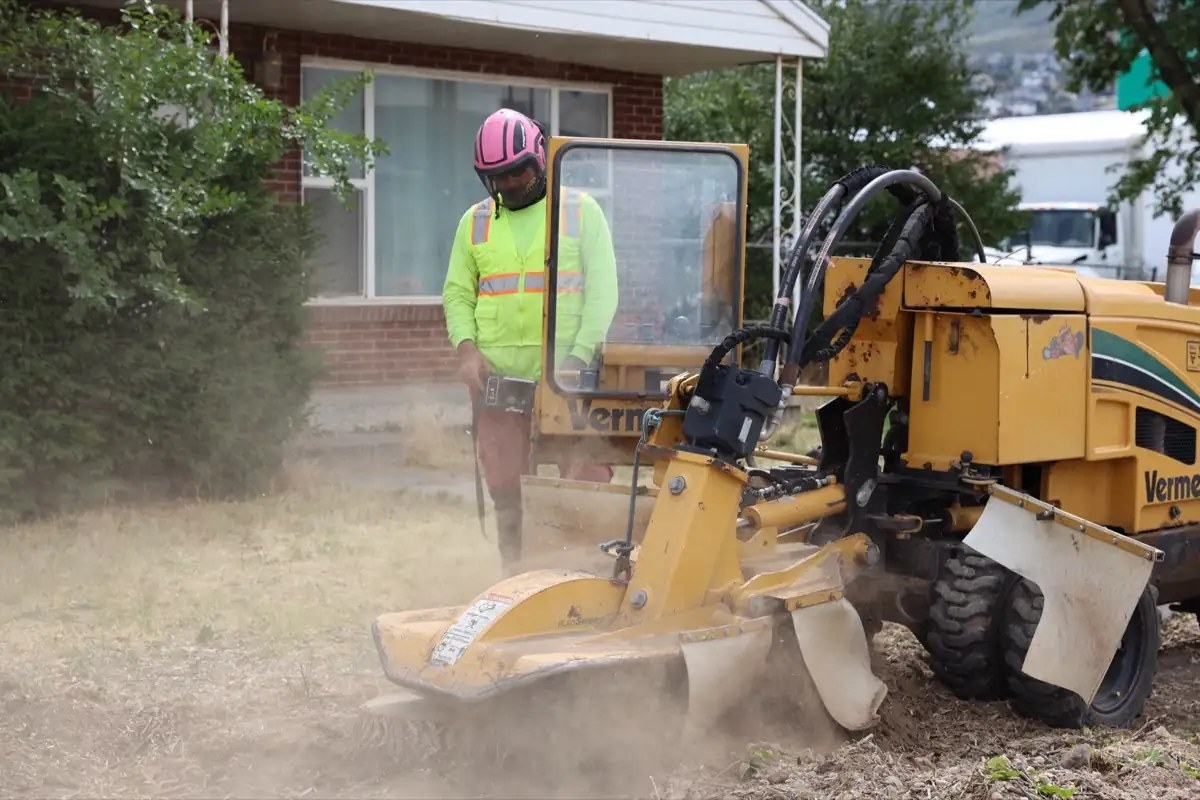
Short answer: most Wasatch Front homeowners need stump grinding, not stump removal. Grinding chips the stump down 6 to 12 inches below the ground so you can plant grass, lay sod or put in a garden bed over the spot. Full stump removal pulls the whole root ball out. It only makes sense if you are building something on that exact spot, pouring concrete, or the roots are already causing damage.
Stump Grinding vs. Stump Removal at a Glance
| Stump Grinding | Stump Removal | |
|---|---|---|
| What it does | Chips the stump down 6 to 12 inches below ground | Digs out the stump and the main root ball |
| Roots | Stay in the ground and break down over time | The main roots come out with the stump |
| What you’re left with | A pile of wood chips and a shallow low spot | A large hole that has to be backfilled |
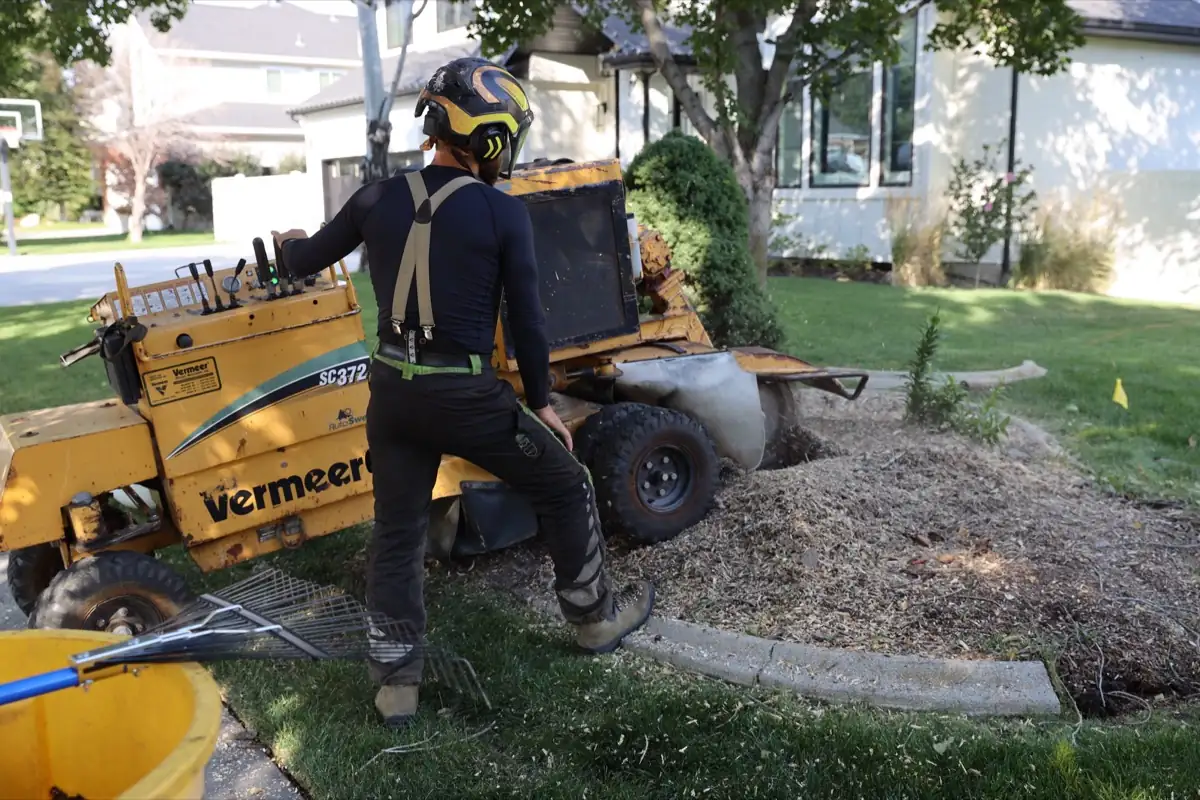
| Equipment | A stump grinder, which fits through most side gates | An excavator or heavy digging equipment |
| Damage to your yard | Small. Mostly the area right around the stump | Bigger. Lawn, sprinklers and nearby plants can get torn up |
| Time | 30 minutes to a few hours per stump | Usually longer, plus backfill and cleanup |
| Cost | Most residential stumps run $150 to $400 | Costs more because of the digging, hauling and fill dirt |
| Best for | Lawns, garden beds and most yards | Foundations, slabs, driveways and replanting in the exact spot |
When Stump Grinding Is All You Need
Grinding is the right call for most yards. Choose grinding if:
- You want to plant grass, lay sod or put in a flower bed where the stump was.
- The stump is in a backyard you can only reach through a gate. A grinder fits where an excavator can’t.
- You want to keep the lawn, sprinklers and plants around the stump in one piece.
- You have several stumps. A grinder can do them all in one visit, usually the same day.
The roots left in the ground are dead once the tree is gone. They slowly break down over the next few years. For lawns and garden beds, that’s not a problem.
When Full Stump Removal Makes Sense
Pulling the stump and root ball is a bigger job. It’s worth it in a few cases:
- You’re building on the spot. A shed, an addition, a patio slab or a driveway needs solid ground. Old roots rot and leave empty pockets in the soil. Under concrete or a foundation, those pockets can cause settling and cracks later.
- You want a new tree in the exact same hole. New roots struggle to grow through a mat of old ones. Many people just plant a few feet over instead, and grinding works fine for that.
- Roots are already lifting a sidewalk, driveway or foundation. Grinding the stump won’t fix roots that are already causing damage.
- You’re clearing a whole lot. For new construction, stumps usually come out with an excavator as part of land clearing.
Removal digs a large hole, so Utah law requires a call to Blue Stakes (811) before the digging starts. That gets buried gas, power and water lines marked first.
What About Cottonwood Stumps?
Cottonwoods are common on older lots across the Salt Lake Valley, and they cause the most trouble. After the tree comes down, the roots often keep sending up new sprouts, sometimes a whole ring of them coming up through the lawn.
You usually don’t need full removal to stop that. Grinding deeper and wider around the root flare takes care of most of it. Tell your crew it’s a cottonwood when you call. Our stump grinding price chart lists deep root grinding as an add-on of $50 to $100.
Utah Soil Matters Too
Much of the Wasatch Front sits on clay, with rock and caliche close to the surface in some neighborhoods. Roots in clay spread wide instead of deep. A stump that looks 20 inches across can have roots reaching several feet out.
That has two effects. Grinding takes longer, because the crew has to grind out the root flare around the edges, not just the trunk. Full removal gets much bigger, because pulling a wide, shallow root system tears up a lot of yard.
What to Do After the Stump Is Ground
- Decide on the chips. Leave them to settle and break down, rake them into garden beds as mulch, or have them hauled away. Haul-away is an add-on.
- Fill the low spot. Rake out most of the chips and fill the hole with topsoil, a little higher than the lawn, because it will settle.
- Feed the soil before you seed. Fresh wood chips pull nitrogen from the soil as they break down. Mix some fertilizer into the topsoil or new grass may come in yellow.
- Watch for sprouts. If shoots pop up around the old stump, clip them low as soon as they show. This is most common with cottonwood, poplar and some elms.
Not Sure Which One You Need?
Tell us what you plan to do with the spot. Is it a lawn, a garden bed, a new tree or something built? That answer usually decides it. We’ll measure the stump, look at the access and give you an exact price before any work starts. The estimate is free.
See our stump grinding service and price chart, or call (801) 262-1596.
Frequently Asked Questions
Is stump grinding as good as stump removal?
For lawns, garden beds and most yards, yes. Grinding takes the stump down 6 to 12 inches below the ground, which is enough to plant over. You only need full removal if you’re building on the spot, pouring concrete or the roots are already causing damage.
Will a ground stump grow back?
The stump itself won’t grow back, but some trees send up sprouts from the roots left behind. Cottonwood, poplar and some elms do this the most. Grinding deeper around the root flare and clipping any sprouts early usually stops it.
Can I plant a new tree where a stump was ground?
Yes, but it’s easier a few feet away from the old spot. The ground stump and old roots make it hard for a new tree to get established right in the same hole. If you need the same spot, ask for deep root grinding.
Do I need a permit to grind or remove a stump in Utah?
Stump grinding usually doesn’t need a permit, because the tree is already down. If the tree was in a park strip or the city right-of-way, check with your city first. Salt Lake City has its own rules, covered in our Salt Lake City tree removal permdit guide.
How long do the roots take to rot after grinding?
It depends on the tree and the soil, but usually several years. Softwoods and smaller roots break down faster. Large cottonwood and oak roots take the longest. This doesn’t affect lawns or garden beds planted on top.

