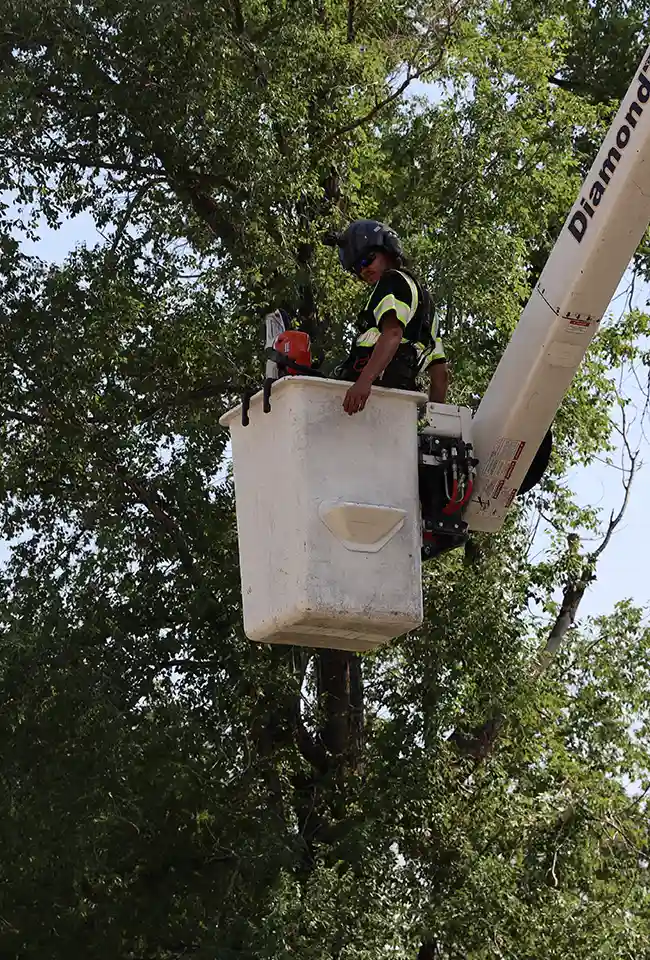
Tree Inspections In Salt Lake City And Along The Wasatch Front

A tree inspection is a certified arborist looking your tree over, top to bottom, and telling you straight whether it’s fine, whether it needs work, or whether it’s a problem waiting to happen.

Some people call it a tree risk assessment. Some call it an arborist evaluation. Same thing. Somebody who knows trees reads the signs you can’t, and you find out where you stand before a limb comes down on your car.

We’ve done this on the Wasatch Front since 1967, and we’ve got four certified arborists on the crew. Diamond Tree Experts perform tree inspections almost every day of the week.  Call to schedule yours today.

What A Certified Arborist Checks During A Tree Inspection

Diamond Tree Experts certified arborists start their tree inspection at the top. Top of the tree down to the dirt, in that order, because the trouble hides in different places.

Up in the crown, we’re looking for deadwood. Dead branches up top get called widow makers for a reason, they drop on a calm day for no reason at all, and they land on whatever’s under them. Thin or off-color foliage, bare patches, a canopy that’s lopsided or dying back on one side. All of it says something.

Down the trunk, it’s cracks and cavities and decay. A crack or split in the trunk, or a tree with two trunks growing tight together, has a high chance of failing. We look for fungus too. Mushrooms or hard conks at the base or on the trunk are usually the first sign of rot working through the inside of the tree.

Then the base and the roots, which is the part most people never think to check. A sudden lean, soil heaving or cracking on one side of the trunk, visible root decay, those point to root failure. And roots are the hard ones. Root defects are the most important thing structurally and the toughest to spot from the surface.

Here’s the catch that makes an inspection worth it. A tree doesn’t have to look dead or sick to be dangerous. A structurally bad tree that looks perfectly healthy can fail just as hard as a dead one. The stuff that’s easy to see, you’d probably catch yourself. It’s the rest that we’re there for.

Get your free ESTIMATE

Contact Us

Give Us a Call:  (801) 262-1596

When A Tree Defect Turns Into A Hazard Tree

This part trips people up, so it’s worth being clear about.

A defect only matters if something’s in the way when the tree fails. Arborists call that something the target, the people or property that would get hit. A tree leaning over a driveway or a kid’s play area rates higher than the same tree out on the back edge of the lot with nothing under it.

So part of what an inspection tells you is not just “is this tree bad,” but “does this tree’s problem actually put anything at risk.” A rotted-out snag in the far corner of an acre lot might be fine to leave. The same tree over your patio is a different call entirely.

That’s why we don’t just look at the tree. We look at what’s under it and around it. The answer changes with the target.

hazardous tree identification

When A Tree Defect Turns Into A Hazard Tree

This part trips people up, so it’s worth being clear about.

A defect only matters if something’s in the way when the tree fails. Arborists call that something the target, the people or property that would get hit. A tree leaning over a driveway or a kid’s play area rates higher than the same tree out on the back edge of the lot with nothing under it.

So part of what an inspection tells you is not just “is this tree bad,” but “does this tree’s problem actually put anything at risk.” A rotted-out snag in the far corner of an acre lot might be fine to leave. The same tree over your patio is a different call entirely.

That’s why we don’t just look at the tree. We look at what’s under it and around it. The answer changes with the target.

When To Schedule A Tree Risk Assessment

Trees don’t run on a warning light, so a few situations are your cue to call.

After we have some of our bad Utah winter weather is the usual time we get our biggest amount of calls. 

It’s smart to have trees looked at after severe storms, and to inspect them before and after heavy snow. The 2020 canyon windstorm made that case for a lot of people on the east bench, where the mature conifers and cottonwoods took the hit first. Wet fall snow that lands before the leaves drop does its own damage.

Before you build, too. If you’ve got a renovation, an addition, or any digging going near a tree, get it inspected first, because construction beats up root systems and stresses the tree for years after. An arborist can tell you how to protect it before the excavator shows up.

And when you see something off. A new lean. Deadwood collecting up top. A crack you hadn’t noticed. Fungus at the base. Leaves that came in thin or the wrong color. Any of that is worth a look.

Buying a house counts too. A mature tree near the house is a big thing to inherit blind, and an inspection before you close tells you what you’re taking on.

As for how often when nothing’s obviously wrong, the general guidance runs from once a year to every three years for healthy trees, depending on the tree, the property, and the climate. Older neighborhoods with big 1960s and 70s trees near the house are on the shorter end of that.

Our Services

large tree removal

Tree Removal

tree trimming

Tree Trimming

stump grinding

Stump Grinding

mulch

Mulch Products

green waste dumping

Green Waste Dumping

demolition

Demolition

Level 1, 2, And 3 Tree Risk Assessments Explained

Not every inspection is the same depth. There’s a system to it, three levels, and it’s worth knowing which one you’re getting.

A Level 1 is a basic visual pass, looking for the obvious visible signs of trouble. 

A Level 2 is the detailed one, a full walk-around of the tree, 360 degrees, up close. That’s the standard assessment most trees get.

A Level 3 is the deep one, and it only comes up when an arborist suspects rot inside the tree that can’t be seen from outside. 

That’s when a tool like a resistograph comes out, a fine needle drilled into the root flare to read how much solid wood is actually left. Most trees never need that. When one does, you’re glad the option exists, because internal decay usually runs unseen until it’s bad, and by the time it shows on the outside the tree may have already lost real strength.

Your Options After The Inspection: Pruning, Cabling, Or Removal

An inspection isn’t a sales pitch for a tree removal. The honest outcome is one of a few things, and cutting the tree down is only one of them.

The call might be pruning, taking the deadwood out and lightening the load. It might be cabling or bracing, where a weak crotch or two competing stems get supported with hardware, or a leaning tree gets cabled, to hold it together instead of losing it. It might be watering, soil work, or protecting the root zone. It might be monitoring, where the right answer is to leave it and check it again next year.

And sometimes it’s removal, when nothing else makes the tree safe.

That’s the part where having a real arborist matters. Cutting is the easy half of tree work. Knowing what should be cut, and what shouldn’t, is the harder half, and it’s the whole point of getting an inspection before anybody fires up a saw.

Tree Inspection Reports For Insurance, HOAs, And Liability

There’s a reason beyond the tree itself to get this documented.

If a tree on your property was clearly a hazard, and you left it, and it comes down on a neighbor’s house or a person, that can land on you. A written inspection from a certified arborist puts your trees on record, shows you took a look, and gives you a plan. Those written assessments are the kind HOA boards and insurance carriers accept, too.

So an inspection isn’t only about saving the tree or catching a hazard early, though it does both. It’s a paper trail that says you handled it.

If you’ve got a tree you’re unsure about, near 500 West or anywhere across South Salt Lake, that’s the call to make. We’ll come look before anything gets decided.

Fifty seven years on the Wasatch Front. Four ISA certified arborists. A straight answer on whether that tree needs work, needs watching, or needs to come out.

Serving Salt Lake, Davis, Utah, and Weber counties.

Frequently Asked Questions

How Often Should I Have My Trees Inspected?

For healthy trees, somewhere between once a year and once every three years is the usual guidance, depending on the tree and where it sits. You’ll also want one after extreme weather like a big storm or a drought, and any time you notice decaying branches or pests. Older trees close to the house are worth checking on the shorter end of that range.

What’s The Difference Between A Tree Inspection And A Tree Risk Assessment?

Nothing, really, they’re two names for the same job. A tree inspection, also called a tree risk assessment, is a professional look at a tree’s health, structure, and overall safety, done by a certified arborist. Some folks also call it an arborist evaluation. Whatever you call it, you’re paying for a trained read on where the tree stands.

Can A Tree Look Healthy And Still Be Dangerous?

Yes, and that’s exactly why an inspection is worth it. A tree doesn’t have to be dead or visibly sick to be a hazard, and a structurally compromised tree that looks fine can fail just as badly as a dead one. A lot of the worst problems, like internal rot, don’t show on the outside until they’re already serious.

Should I Get My Trees Inspected Before Construction?

Yes, before any of it starts. Major landscaping, additions, or excavation near a tree can wreck the root system and stress the tree for years, so an inspection beforehand is smart. An arborist can also tell you how to protect the tree while the work’s going on, which is cheaper than losing it later.

What Does An Arborist Check During An Inspection?

They read the tree from the crown down to the roots. That means the foliage color and density up top, deadwood in the crown, cracks and cavities and decay in the trunk, and defects down at the roots, which are the most important and the hardest to spot. They also weigh what’s under the tree, since a defect only matters if something would get hit.

Do You Just Recommend Removal Every Time?

No. The recommendation depends on what we find, and removal is only one of several. It might be pruning out deadwood, cabling or bracing a weak union, or supporting a leaning tree, instead of taking it down. Sometimes the right answer is to water it better, protect the roots, or just watch it and check again next year.

Diamond Tree Experts Service Area

salt lake city

Salt Lake City

draper

Draper

sandy

Sandy

ogden utah

Ogden

layton

Layton

riverton

Riverton