
Spring Tree Trimming in Utah | Timing, Technique, and What Goes Wrong
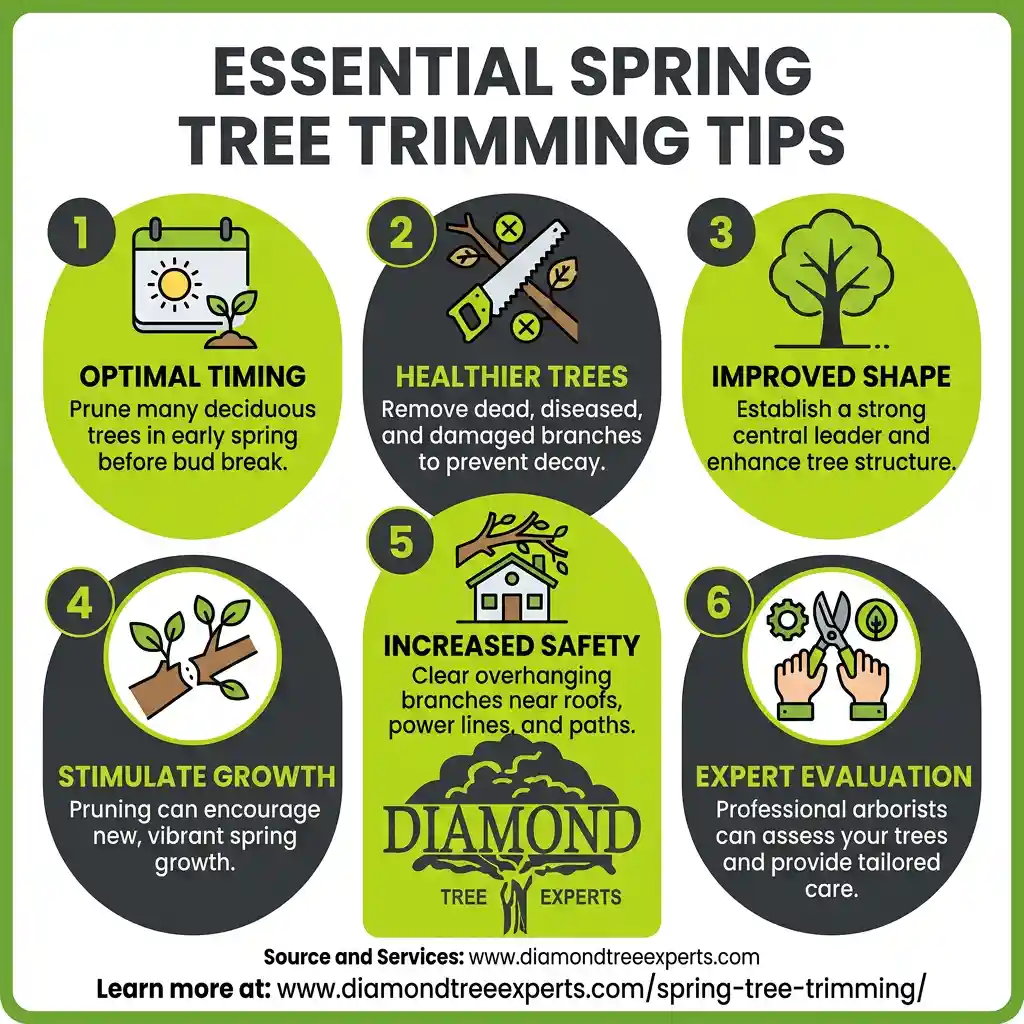
Spring tree trimming in Utah should happen between late February and mid-April for most species in the Salt Lake Valley.
That’s the window.
Before bud break, after the worst cold, while the tree still has energy moving toward active growth rather than already committed to it.
Miss that window and you’re making fresh cuts during peak bark beetle activity, which in Utah runs May through June. Open wounds and active beetles are a bad combination.
Elevation shifts the timing. Properties on the east bench above 4,500 feet can run two to three weeks behind the valley floor.
A tree in Cottonwood Heights that’s still dormant in early March may already be pushing buds in South Salt Lake.
That’s not a small difference when you’re trying to time pruning cuts for maximum wound closure. It’s also why a trimming schedule that works for one property doesn’t automatically transfer to another one a few miles away.
Understanding Spring Tree Trimming
Best Timing for Pruning and Trimming
There isn’t one answer that works for every tree. That’s the honest version of it.
Cottonwoods, ash, and most deciduous shade trees do best with late dormancy pruning. End of February into March for most of the valley.
Ornamental pears and flowering crabapples are different. Prune those before bloom and you’re removing next year’s flower buds. Wait until after the bloom drops, then prune. Flowering cherries and ornamental plums follow the same logic.
Evergreens are later. Austrian pine and blue spruce are typically handled in late spring after the new candle growth has extended but before it hardens off.
Get the timing wrong on a spruce and you lose a full year of growth in that section. Oaks need to be pruned in late winter specifically because of oak wilt. The beetles that spread it are most active when fresh wounds are exposed in warmer months.
The point is: a single spring pruning schedule applied to every tree on a property is going to be wrong for at least some of them.
Risks of Improper Trimming
Topping is the one that causes the most lasting damage.
It shows up constantly in older neighborhoods throughout Murray, South Salt Lake, and the Jordan River corridor.
Cutting back to arbitrary points along the main limbs removes terminal growth and forces the tree to produce multiple fast-growing but weakly attached sprouts below the cut.
Those sprouts are the hazard branches of the next decade. No ISA-certified arborist recommends topping. Not in any circumstance.
Over-pruning is a different problem but almost as common.
Removing more than 25 percent of the live canopy in one season reduces the tree’s ability to photosynthesize and recover.
A lot of property owners try to fix years of neglect in one visit. That usually creates more problems than it solves.
Spreading the work over two or three seasons is the right approach when a tree is significantly behind on structural pruning.
Late-season pruning, specifically anything done in late summer or fall, stimulates new growth that doesn’t harden before winter. Utah temperatures can drop hard in October. That new growth gets damaged and the tree enters dormancy stressed, with open wounds.
Common Spring Tree Trimming Mistakes to Avoid
Over-Pruning the Canopy
The 25 percent rule is worth taking seriously.
A lot of people see spring as a reset, take it all back, clean it up, start fresh. But, heavy removal in a single season sets the tree back considerably.
Focus on the wood that actually matters: dead branches, damaged or broken wood, crossing limbs that are rubbing bark off each other, co-dominant stems with included bark, and branches with excessive end weight hanging over structures.
That’s the list. It’s not a short list on a tree that hasn’t been touched in 15 years, but it’s a focused one.
Neglecting Species-Specific Needs
This is where a lot of DIY spring trimming goes sideways. Different species have different relationships with timing, and the Wasatch Front has enough variety in a single yard( cottonwood, silver maple, Austrian pine, flowering cherry, blue spruce) that a blanket approach is almost guaranteed to be wrong for something.
Utah’s alkaline clay soil adds another layer to this.
Trees in heavy clay near the Jordan River corridor develop differently than the same species in amended soil two miles east. They respond to pruning stress differently.
Root systems in slow-draining clay can be more compromised than the canopy lets on.
A qualified arborist who knows these conditions is assessing more than just what’s visible.
Proper Cutting Techniques
Every cut gets made just outside the branch collar.
The collar is the slightly swollen tissue where the branch meets the trunk or parent limb.
Cut flush with the trunk and you’ve removed the tissue the tree uses to compartmentalize and close the wound.
Leave a long stub and decay moves inward from there. Both of those are wrong, and both are common.
On any branch over roughly two inches in diameter, the three-cut method prevents bark tearing.
First cut goes partway through the underside of the branch, 12 to 18 inches out from where the final cut will be.
Second cut comes from the top just beyond the first, removing the weight.
Third cut is the finish cut just outside the collar. Skipping the undercut on a heavy limb and cutting straight through almost always results in the branch stripping bark down the trunk as it falls.
Tools need to be sharp. A dull blade tears rather than cuts. And disinfecting between trees matters, especially if there’s any visible disease. A 10 percent bleach solution or 70 percent isopropyl alcohol both work. Isopropyl is easier on the metal long-term.
Aftercare and Maintenance for Trimmed Trees
Watering and Fertilization Post-Trimming
Deep, infrequent watering supports recovery better than frequent shallow watering. The root zone on a mature tree extends well beyond the drip line of the canopy. Watering only at the trunk base doesn’t reach most of those roots.
Don’t fertilize immediately after trimming. Wait until new growth signals the tree has stabilized, then a nitrogen-focused fertilizer supports foliage and root development. Fertilizing too early pushes the tree before it’s ready to respond.
Supporting Recovery and New Growth
Mulch does more for a trimmed tree than most people expect.
A three to four inch layer of wood chip mulch around the root zone, kept back from direct contact with the trunk, retains soil moisture through dry Utah summers, moderates soil temperature, and reduces compaction.
The residential streets in South Salt Lake and Murray have a lot of trees struggling in depleted, compacted soil. Mulch addresses that directly and without a lot of effort.
Avoid any soil compaction around the root zone during and after pruning work. Keep equipment and foot traffic off the root zone if possible.
And if the tree underwent significant trimming, check its stability before storm season. A tree that’s been heavily worked is adjusting its weight distribution and may need monitoring before the first serious canyon wind event.
When to Hire a Professional Tree Trimming Service
Recognizing Difficult or Hazardous Jobs
Anything hanging over a roofline. Anything near a power line. Any tree with a new lean, visible trunk cracks, or soft wood at the base. Co-dominant stems with included bark on a tree over 30 feet. These aren’t jobs to figure out on the fly with a rented saw.
The most dangerous situation after a storm is a hanging limb, still attached at a hinge point and not fully down. That needs to come down before anyone walks under it. That’s an emergency call, not something to leave until the weekend.
Benefits of Professional Expertise
Diamond Tree Experts has four ISA-certified arborists on staff.
That’s not the same thing as having experienced climbers. ISA certification covers tree biology, risk assessment, and pruning standards.
It’s the difference between someone who knows what a co-dominant stem with included bark looks like from the ground and someone who just knows how to run a saw.
We’ve been working on Utah trees since 1967.
Our arborists know what happens to Wasatch Front cottonwoods after a drought year followed by a heavy snow season. They know which pest and disease pressures are active in the valley right now. They’ve worked these specific neighborhoods, these lot sizes, these species, and this soil for decades. That’s not something you get from a national franchise rotating crews in from out of state.
Choosing Reliable Spring Tree Trimming Services
Licensed, insured, and bonded is the baseline. Ask for proof.
Beyond that, ISA certification on staff is the credential that matters most for tree work specifically.
Get a written estimate before any work starts. A company that won’t put the scope and cost in writing before showing up with equipment is a company worth passing on.
If you have trees that need attention before spring gets away from you, call Diamond Tree Experts. We’ll come out, look at the trees, and give you a straight answer on what needs to happen and what it costs. No pressure, no upsell.

