
Stump Grinding Cost in Utah: What Most Homeowners Pay
Most stump grinding jobs on the Wasatch Front cost between $150 and $400. That’s not a guarantee, it’s just what the majority of residential grinds actually come out to when you factor in a typical yard, a typical stump, and a crew that isn’t fighting terrible access conditions.
Smaller ornamental stumps, a dead crabapple, a globe willow that finally came down, those can run under $100.
On the other end, a cottonwood that’s been growing since the Eisenhower administration with a 40-inch base and roots spreading halfway across the backyard is a different job entirely.
Six hundred dollars isn’t an unusual stump grinding cost for something like that. Sometimes more.
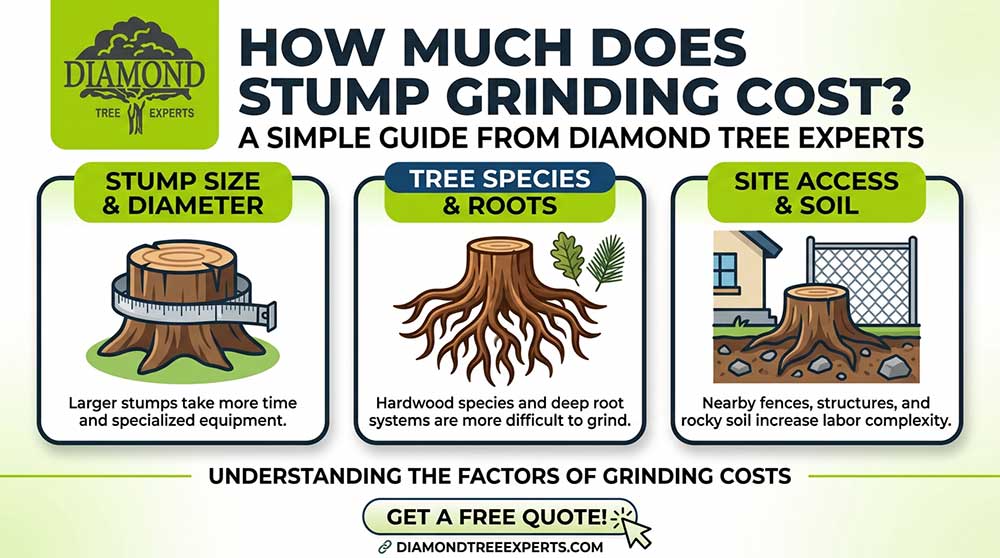
What Affects Stump Grinding Cost on the Wasatch Front?
Companies price this work one of two ways.
Most charge per inch of diameter, measured at the widest point right at ground level.
In northern Utah that rate generally runs $3 to $6 per inch, though it moves around depending on the company and the conditions. The per-inch math makes sense on larger stumps.
On smaller ones it usually doesn’t matter, because almost every contractor also charges a minimum to show up at all.
That minimum covers loading the grinder, driving to your address, and setting up. Typically $100 to $150. If your stump is small enough that the per-inch math comes out below that, you’re paying the minimum.
Multiple stumps on the same visit changes the math. The cost to drive to the job is already covered after the first one.
Additional stumps are cheaper, sometimes substantially. Four stumps spread across a property that’s been accumulating them over the years is a much better value scheduled together than called in one at a time.
Why Cottonwood, Silver Maple, and Utah Clay Soil Change the Stump Grinding Cost Price
Generic cost guides pull national averages. Those numbers don’t map cleanly onto Wasatch Front properties for a couple of reasons.
The soil here is alkaline clay. Most of Salt Lake, Davis, Utah, and Weber counties, same story.
Roots don’t sink deep in clay, they spread wide because vertical penetration is slow.
So a stump that looks like a manageable 20-inch diameter at the surface might have a root flare pushing out six feet. That’s more grinding area than the diameter measurement alone suggests, and it adds time to the job.
Species. Cottonwood is everywhere on older Wasatch Front properties.
Murray, Holladay, South Salt Lake, Sandy, the neighborhoods that were being developed in the ’50s and ’60s. Those trees are 60-plus years old now.
Trunk diameters in the 30 to 40 inch range are not uncommon near the Jordan River corridor where soil moisture runs higher and cottonwoods grow faster than they do on drier lots.
Silver maple is nearly as common on mid-century residential streets, and it’s dense. Both take longer than a pine or an ornamental fruit tree. That difference shows up in the quote.
Access matters and it’s one of the things homeowners forget to mention when they call.
A stump in an open front yard is a simple setup. A stump with a fence three feet away, a narrow side gate the grinder barely clears, an irrigation manifold somewhere in the general area, a deck overhead, that’s a more complicated job.
Mention site conditions when you call. A quote given without that information isn’t accurate.
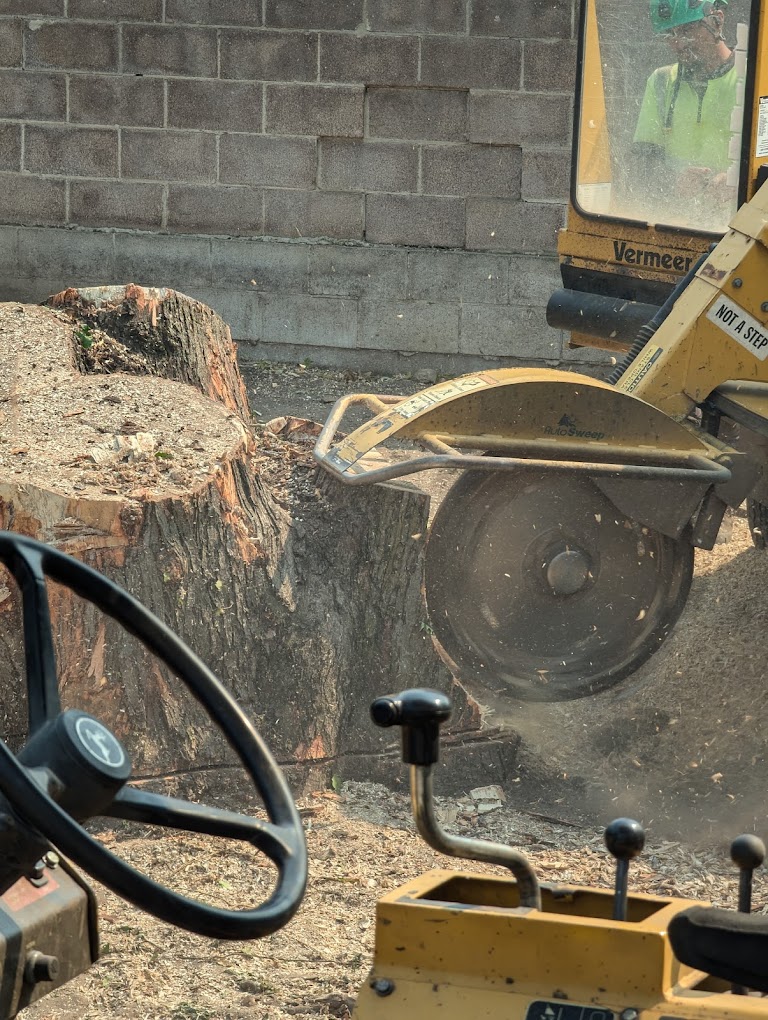
Wood Chip Removal After Stump Grinding: Haul Away or Keep the Mulch
Grinding leaves a pile of chips.
What happens to them depends on which company you hire and what they include in the price. Some build haul-away into the base cost. Some don’t, and the debris removal shows up as a separate line at the end.
It’s definitely worth asking before the crew shows up. Hauling typically adds $50 to $150.
The chips themselves are useful, and a lot of homeowners don’t know that.
Three to four inches of wood chip mulch spread around your other trees, kept a few inches back from the trunk base, holds soil moisture through dry Utah summers, moderates soil temperature, and reduces compaction in the root zone.
We deliver bulk mulch across the Wasatch Front. This is exactly what that is. If the crew is loading chips to haul away, ask whether they can leave some. Usually not a problem.
Stump Grinding vs. Full Root Removal
Not the same service.
Stump grinding takes the visible stump down and goes several inches below grade.
The lateral roots stay. They decay underground over time, which for most purposes (replanting lawn, putting in a garden bed, re-grading the area,) is fine. Six to eight inches below grade is enough to landscape over without issues.
If you’re planning to pour a slab, build anything with a foundation, or plant a new tree in that exact location, the roots are going to be in the way.
Root decay creates voids in soil.
In clay that drainage is already slow, and a void under a structure or hardscape is a future problem.
Full root removal is a separate service, more labor-intensive, and priced differently. Know what you’re doing with that space before you decide what to book.
Cottonwood is the species where this comes up most often.
Grind one and leave root mass behind and the root system keeps pushing sprouts. Not a few, a ring of them, sometimes a dozen, coming up through the lawn around where the stump was.
We’ve come back to properties six months after grinding a cottonwood and found exactly that.
Grinding deep, or treating the remaining root tissue, is part of finishing the job right on that species.
Why Leaving a Tree Stump in the Ground Can Lead to Bigger Problems
The stump doesn’t feel urgent once the tree is down.
That’s the typical thinking and it’s understandable.
But, decay draws carpenter ants and wood-boring beetles, and on the Wasatch Front, bark beetle pressure on Austrian pine and blue spruce is not an abstract concern, it’s active.
A rotting stump close to healthy conifers is a reservoir. Root rot moves through soil contact between root systems. The damage to an adjacent tree can be significant before anything shows up in the canopy, and by the time it does you’re often already past the point of saving it.
The grinding cost is a few hundred dollars. Removal of a mature tree that died from root disease it picked up from an unground stump next to it is considerably more. That math isn’t complicated.
Getting a Stump Grinding Number That’s Actually Accurate
Measure the stump’s diameter at the widest point at ground level before you call.
Take a couple of photos, one of the stump itself and one showing the access path to it and any visible surface roots.
If there are access complications, utilities nearby, an irrigation line in the area you’re aware of, say so.
A company that asks about site conditions before quoting is giving you a real number. One that doesn’t ask isn’t.
On DIY: renting a grinder runs $150 to $250 a day.
Rental units are nowhere near as powerful as commercial machines.
A large hardwood stump in clay can realistically eat a full rental day.
Add in the safety considerations of working near utilities you can’t locate and the learning curve on equipment you’ve never operated, and for most homeowners with a couple of stumps to deal with, the professional option is comparable in cost and a lot lower in risk.
Diamond Tree Experts – Stump Grinding Cost Experts
We’ve been doing this work across the Wasatch Front since 1967.
With four ISA-certified arborists on staff. We know what a 40-inch cottonwood base in alkaline clay looks like and what it takes to grind it correctly.
We know the difference between a quote given over the phone based on a diameter measurement and what the actual job looks like when the crew gets there, and we try to close that gap before we show up.
We serve residential, commercial, HOA, municipal. Salt Lake, Utah, Davis, and Weber counties.
Call us for a free estimate. We’ll come out, look at the conditions, and give you a straight number.

