Sugar House
Tree Service in Sugar House, Salt Lake City
Sugar House has trees that have been in the ground since the 1940s and ’50s, some longer.
The neighborhood developed early, the lots are older, and the canopy that grew up around those homes has been accumulating wood and risk for decades in some cases without anyone touching it.
That’s the situation a lot of property owners here are actually dealing with, not brand-new trees in a clean yard, but big mature shade trees with complicated root systems, branches over the roofline, and no real pruning history.
Diamond Tree Experts has worked Salt Lake City trees since 1967. With four ISA-certified arborists on staff, we cover Sugar House and the surrounding neighborhoods year-round.
Tree Care in Sugar House Is Different From Newer Parts of the Valley
The soil across most of Salt Lake City, including Sugar House, is alkaline clay. It compacts easily, drains slowly, and changes how root systems develop. Roots in heavy clay often spread wide and shallow rather than deep. Which matters a lot when you’re trying to assess whether a 60-foot cottonwood is actually stable or just looks that way from the street.
Sugar House also catches canyon wind. Events that push through from the east and southeast hit the older residential blocks between Highland Drive and 700 East without much to slow them down. Wet snow in October and November, before leaf drop, loads the canopy heavier than most people expect. Old wood plus clay soil plus tight lots is a bad combination when something lets go.
The trees you’re most likely dealing with in Sugar House:
- Cottonwoods near the older property lines and along 2100 South
- Silver maples throughout the mid-century streets
- Siberian elms that seeded in and got large fast
- Austrian pine in the ’70s and ’80s yards
- Ornamental pears and cherries near Westminster University and the newer infill corridors.
Get your free ESTIMATE
Give Us a Call: (801) 262-1596
Each species has different failure patterns and different pruning requirements.
Tree Trimming and Pruning in Sugar House
Most trees in Sugar House that haven’t been touched in ten or fifteen years have the same set of problems. Co-dominant stems with included bark developing in the upper canopy. Interior deadwood that doesn’t get noticed until a branch drops. End weight on long horizontal limbs extending over structures with nothing reducing the load. None of that is cosmetic. It’s structural.
Structural pruning means identifying and removing the wood that creates actual hazard, not trimming back to a tidy perimeter. Crown thinning reduces wind resistance across the whole canopy. Deadwood removal takes out the drop risk. Canopy reduction keeps limbs clear of roofs, fences, driveways, sidewalks, and power-line-adjacent areas on the residential streets near Forest Dale Golf Course and east toward I-80.
Timing is not just a suggestion. For most Utah species, late winter through early spring is when pruning wounds heal fastest. Before bud break, after hard cold. Cuts made mid-summer stay open longer and invite fungal entry. Some ornamentals are different; they get pruned right after bloom. Get this wrong and you’re creating entry points for disease on a tree that was otherwise healthy.
Tree Removal
Some trees in Sugar House need to come out. A silver maple with major included bark unions forty feet up, a cottonwood that developed a new lean after last winter’s wet soil conditions, a tree with visible decay at the root collar, these don’t have good long-term outcomes. Waiting on removal until after a failure costs more and causes more damage than doing it proactively.
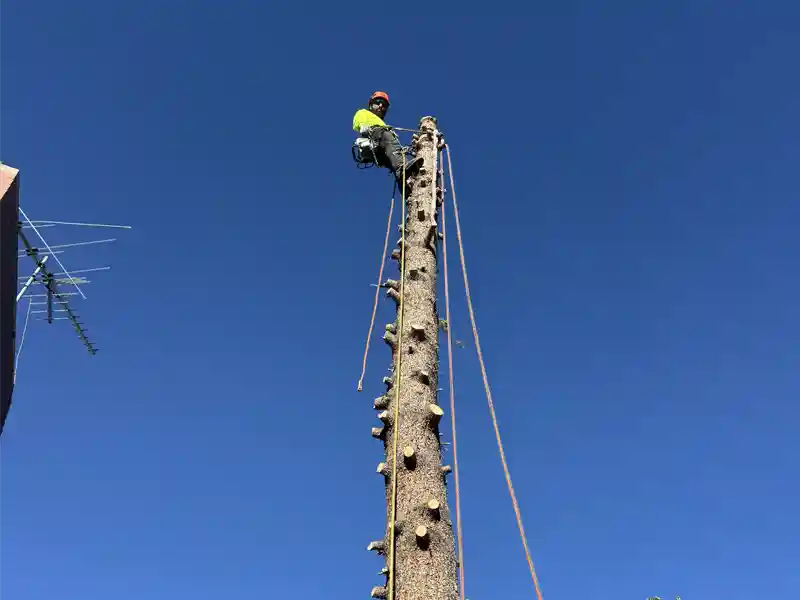
Lots here don’t give you room to work. Homes sit close. Fences run near trunk bases. Utility lines cross through canopy on half the streets between Sugar House Park and the 1100 East corridor. That means sectional work, rigging, controlled lowering. Not every tree company has the equipment or the crew experience for that kind of removal in a tight urban lot. We do.
Salt Lake City has tree permit requirements for certain removals depending on tree size and location. We’ll confirm what applies before anything comes down.
Stump Grinding
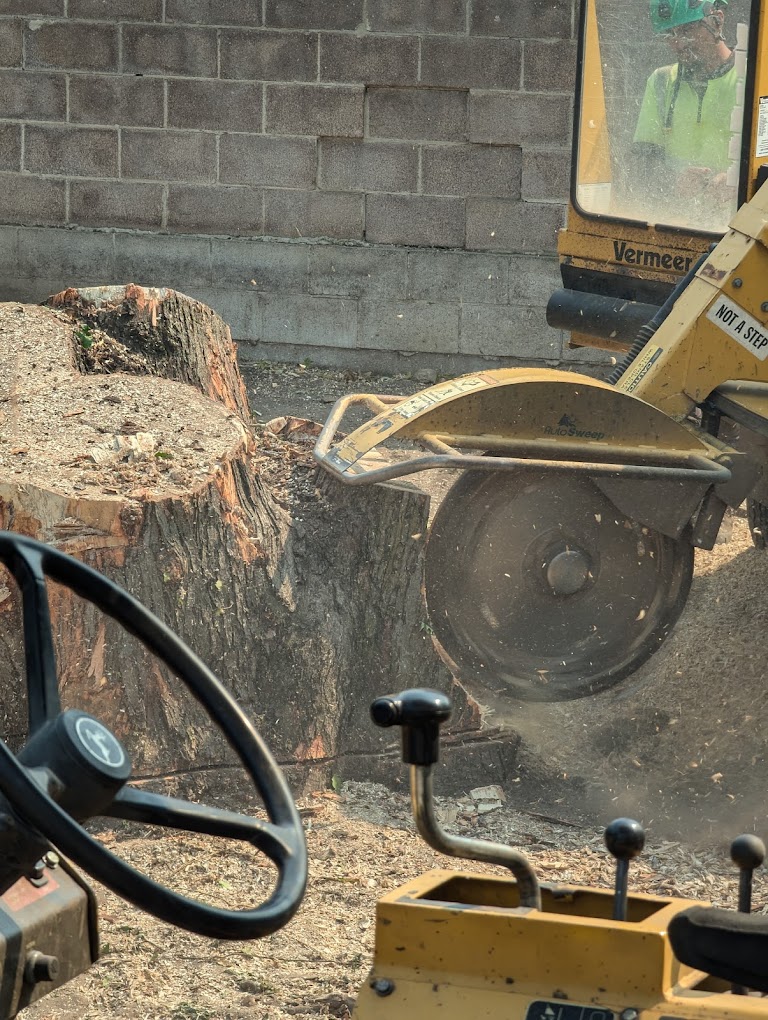
A stump left in place keeps producing problems. Cottonwoods and elms especially will push up root sprouts for years after the tree is gone. Decaying wood draws carpenter ants and wood-boring beetles that move into nearby structures or healthy trees if the stump is close enough. A stump from a diseased tree is a disease reservoir. Root contact between stumps and adjacent trees is a real transmission pathway for root rot, and it operates underground where you won’t see it until another tree starts declining.
We grind to below grade. Depth depends on what’s going in afterward. Chips stay or go, your call. If you’ve got multiple stumps, combine them in one visit. The per-stump cost drops when the setup is already done.
Emergency Tree Service
Wind events in Sugar House move fast and the old cottonwoods take the worst of it. Heavy wet snow before leaf drop is the other major failure driver. When a large limb partially fails and is still hanging at a hinge point, that’s the most dangerous situation, not a tree on the ground but a suspended load that hasn’t finished falling. Nobody should be working or walking under that until it’s down.
We respond to emergency calls throughout Sugar House and Salt Lake City, remove the immediate hazard, assess the rest of the canopy, and give you a straight read on whether the tree is stable enough to leave or needs more work.
Why the Company You Call Matters
A lot of tree companies in Utah are sending laborers with equipment. That’s not the same as ISA-certified arborists who understand tree biology, failure mechanics, and what’s actually happening inside a declining tree before the visible symptoms show up. The assessment quality at the start determines everything else.
We’ve been on the Wasatch Front since 1967. Our arborists know alkaline clay soil, canyon wind patterns, what bark beetle pressure looks like on an Austrian pine in early stages, and what happens to Sugar House cottonwoods after a drought year followed by a heavy snow season. That’s not general knowledge. It’s local and specific.
We’re based in South Salt Lake at 3645 South 500 West, about ten minutes from Sugar House. Licensed, insured, bonded.
Areas We Serve Near Sugar House
We provide Salt Lake City tree service across the surrounding area including Millcreek, Murray, Holladay, South Salt Lake, Liberty Park, Millcreek, and Downtown Salt Lake City. Not sure if we cover your address, call and ask.
Get a Free Estimate
When you need tree service in Sugar House, call us, we’ll come out and look at it, tell you what’s going on and what it costs. No pressure.
For tree service in Sugar House, Salt Lake City, call Diamond Tree Experts at (801) 262-1596.