Trusted Tree Service In Millcreek, Utah

Since 1967

Millcreek has old trees. Not old like fifteen years — old like the cottonwood in your backyard that was already mature when your house was built in 1962. That’s common here. The neighborhoods along Millcreek Canyon Road, off 3300 South, up toward the foothills — a lot of those yards have trees pushing 60, 70, even 80 years in the ground.

Big trees are worth keeping. They also fail in ways smaller trees don’t.

Diamond Tree Experts has worked on Utah trees since 1967. ISA-certified arborists on staff, not just laborers with equipment. If you’ve got a tree situation in Millcreek — routine or urgent — we’ve dealt with it before.

The Trees You’re Dealing With In Millcreek

Mature Canopy Is The Norm Here

Most of the tree problems we get called about in Millcreek involve trees that have been in the ground for decades. That changes the math on everything. A 65-foot cottonwood with a codominant stem over a roof isn’t a trimming job — it’s a risk assessment first, then a removal plan. A 50-year-old blue spruce that’s dropping needles on one side could be root rot, beetle damage, or drought stress from three summers ago finally showing up. Age matters.

Newer subdivisions off the canyon have younger trees and different problems. But the bulk of Millcreek is established neighborhoods, and established neighborhoods have big, old trees that need experienced hands.

Species Common To The Area

Cottonwoods show up constantly — near drainage, in backyards, along older property lines. They grow fast, get enormous, and the wood is brittle. A branch that looks solid can fail under snow load with no warning. Big-leaf maples are everywhere too, especially in the shaded lots closer to the canyon. Blue spruce, Austrian pine, ornamental cherries, crabapples — the mix changes block by block.

Each species has a different pruning window, different failure patterns, different disease vulnerabilities. You can’t treat them all the same way. Pruning a maple in late summer, for instance, opens it to a fungal infection that a winter prune avoids entirely.

Utah Conditions That Affect Your Trees

The soil in most of the Salt Lake Valley is alkaline clay. That affects how roots develop, how water moves through the ground, and how structurally stable a tree gets over time. It’s not a death sentence for trees, but it means a 60-year-old cottonwood here has a different root system than the same species growing in better soil somewhere else.

Add to that: late spring freezes that split trunks. Bark beetle pressure that’s been increasing for years across Wasatch Front pines. Summers that run dry for months. Then a September windstorm comes through and trees that were already stressed drop branches or uproot entirely. That sequence happens here more than people expect.

Tree Services We Provide In Millcreek, Utah

Tree Trimming And Pruning

Tree trimming isn’t just cutting back branches that are in the way. Done right, it removes structural defects — crossing limbs that will eventually wound each other, dead wood that’s a falling hazard, competing leaders that split the tree’s weight badly. Done wrong, it stresses the tree, opens wounds that don’t close properly, and creates more problems in two or three years.

In Millcreek, a big part of what we do is crown work on older cottonwoods and maples that have never been properly pruned. Forty years of growth with no intervention creates a mess of structure. We can clean that up, reduce end weight on long limbs, and get the tree into a shape that’s safer and easier to maintain going forward.

Timing: late winter to early spring for most species. Before bud break, after the worst cold.


Get your free ESTIMATE

Contact Us

Give Us a Call:  (801) 262-1596

milcreek

Tree Services in Millcreek

If you’re in Millcreek and need help with a hazardous tree, routine pruning, or a plant health issue, here are the main services we provide in the area. If you’re not sure what you need, start with tree removal or tree health care and we’ll guide you from there.

Need an estimate in Millcreek? Request a quote here.

Our Services

large tree removal

Tree Removal

tree trimming

Tree Trimming

stump grinding

Stump Grinding

mulch

Mulch Products

green waste dumping

Green Waste Dumping

demolition

Demolition

millcreek tree removal

Tree Removal

We remove trees when there’s no other responsible option.  We remove trees when significant decay, catastrophic structural failure, root damage from construction, disease that can’t be treated, or proximity to a structure that makes the risk too high.

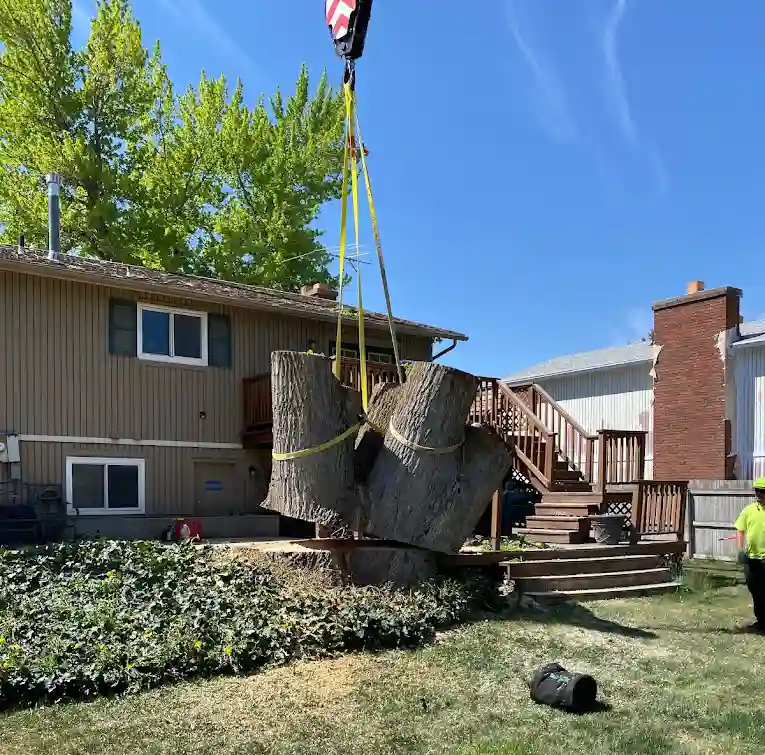
Millcreek tree removal can often be complicated by lot size. Older neighborhoods mean smaller yards, fences close to the trunk, houses tight to the property line. We work in sections, control where everything lands, protect the surrounding yard, and haul the debris out completely. Before we start any removal we’ll also confirm with you whether a permit is required.  Millcreek City and Salt Lake County both have rules on this depending on tree size and species.

Stump Grinding

Leave a stump and you’re not done with the tree. The root system starts decaying, which can spread fungal disease to nearby healthy trees. Beetles move in. The wood eventually becomes a soft trip hazard in the lawn. And if you want to replant in the same spot, the old root mass is in the way.

We offer stump grinding to below grade — deep enough to replant or re-sod over. We bring the right grinder for the access situation, whether it’s tight against a fence or open in a back lawn.

Emergency Tree Services

When something comes down in a storm, the immediate problem is usually a branch or trunk on a structure, blocking a driveway, or still partially attached and hanging. That last one, a hanging limb with a hinge point holding, is the most dangerous and needs to come down before anyone walks under it.

We respond to emergency tree service calls in Millcreek. We get the hazard cleared, assess whether the rest of the tree is stable, and give you a clear picture of what needs to happen next. If the tree needs to come out entirely, we’ll tell you that too. Don’t leave a damaged tree standing without having someone look at it — failure under a second storm load is common.

Mulch Delivery

We deliver bulk wood chip mulch. A 3-4 inch layer around the base of your trees (kept away from the trunk itself) retains moisture through Utah’s dry summers, reduces soil compaction, and moderates soil temperature. It’s one of the most straightforward things you can do for tree health and most homeowners skip it. Order by the yard, we drop it where you need it.

Why Hiring A Local Utah Tree Company Makes A Difference

National Chains Don’t Know Utah Soils

A national franchise sends the same crew with the same approach regardless of where they’re working. They don’t know that alkaline clay behaves differently under mature root systems here. They may not catch early bark beetle signs on a pine that a local arborist sees immediately. They don’t know that the frost pattern in a Millcreek canyon-adjacent yard is different from a yard two miles west.

That gap in knowledge shows up in the work.

57 Years In This Specific Environment

We’ve been working Utah trees since 1967. That’s not a tagline, it’s a lot of accumulated pattern recognition. Our arborists have seen what happens to cottonwoods in this valley after a drought year followed by a wet spring. They know which disease pressures are active right now on the Wasatch Front. They’ve worked in Millcreek specifically, in these lot sizes, with these species, under these soil conditions.

Accountability Matters

We’re a Utah company. We’re not rotating crews in from another state. If something isn’t done right, we’re reachable and we fix it. That matters more than people think until they need it.

When To Call Us

Call Right Away If…

  • A tree or large branch is down on your home, fence, or vehicle
  • A limb is hanging.  Still partially attached, not fully fallen
  • You see a new crack or split in a trunk near a structure
  • A tree is leaning that wasn’t leaning before

Also Worth A Call If…

  • Your trees haven’t been trimmed in three or more years
  • You’re seeing dieback in the upper crown or one-sided needle loss
  • You have a stump that needs to come out before you replant
  • You’re doing construction or landscaping within 15 feet of a mature tree
  • You want mulch delivered for your yard or garden beds

Millcreek Tree Service Area

We work throughout Millcreek and the surrounding Salt Lake Valley: Salt Lake City, Murray, Holladay, Cottonwood Heights, Sandy, Draper, South Jordan, West Jordan, Taylorsville, and Midvale. If you’re not sure whether we cover your area, call and ask.

57 Years Of Utah Tree Care

Diamond Tree Experts has been in Utah since 1967. Our arborists are ISA-certified, which means they’ve passed credentialing in tree biology, risk assessment, and pruning standards, not just apprenticed on a crew. We’ve worked in Millcreek for decades, across multiple generations of homeowners in the same neighborhoods.

A lot of companies in this space send unskilled labor with equipment and call it tree service. We don’t operate that way.

Get A Free Estimate On Tree Service In Millcreek

Got a tree that needs attention? Call us. We’ll come out, look at it, and give you a straight answer on what needs to happen and what it costs. No pressure.

Call Diamond Tree Experts: (801) 262-1596 diamondtreeexperts.com

Serving Millcreek, Utah and the entire Wasatch Front.

Diamond Tree Experts Service Area

salt lake city

Salt Lake City

draper

Draper

sandy

Sandy

ogden utah

Ogden

layton

Layton

riverton

Riverton

Frequently Asked Questions

What is the average cost of tree removal in Millcreek, Utah?

Most tree removals in Millcreek run between $400 and $2,500, depending on tree size, species, and access. A small ornamental tree in an open yard is on the lower end. A large cottonwood or blue spruce in a tight residential lot — with overhead lines, a fence, and a house close by — is on the higher end. Crane-assisted removals cost more but are sometimes the only safe option.

The best way to get an accurate number is an on-site estimate. A lot of variables affect the price and they're hard to assess without seeing the tree. Contact us for a free estimate and we'll give you a straight number before any work starts.

What is the 5-15-90 rule for tree felling?

The 5-15-90 rule is a professional guideline used during directional felling. The notch cut should be no deeper than one-fifth (20%) of the trunk diameter. The hinge wood — the strip of wood left to control the fall direction — should be roughly 80% of the diameter and 10% of the diameter in thickness. The back cut is made at 90 degrees to the intended fall line.

This matters in Millcreek because a lot of the trees here are large and in tight lots. A miscalculated fell direction means the tree lands on a fence, a roof, or a neighboring yard. Proper hinge wood control is what prevents that. It's one of the reasons sectional removal — taking the tree down in pieces from the top — is often the safer approach in dense residential neighborhoods.

Do I need a permit to remove a tree from my property in Millcreek, Utah?

It depends on where the tree is located. For private trees fully on your property, Millcreek City generally does not require a permit for removal. However, if the tree is in the park strip (the area between the sidewalk and the curb), it's considered a public tree and you'll need approval before any work is done.

Salt Lake County also has tree protection requirements that can apply depending on lot size and development activity. If you're doing a larger landscaping or construction project, that triggers a separate review. When in doubt, call Millcreek City's planning department before you schedule the removal. We can also walk you through what applies to your specific situation when we come out for an estimate.

How big of a tree will cost $1,000 to remove?

Generally, a tree in the 30 to 50-foot range with moderate access — meaning a crew can get equipment reasonably close, there are no major overhead obstacles, and the tree isn't directly over a structure — will fall around the $800 to $1,200 range.

In Millcreek specifically, the complicating factor is lot size. A 35-foot tree in an open backyard might come in under $1,000. The same size tree wedged between two fences with a utility line running through the canopy could run $1,400 or more because of the extra time and rigging involved. Size is one factor — access and risk are the others.

What time of year is the cheapest for tree removal?

Late fall through early winter — roughly November through February — tends to be the slowest period for tree work in Utah, and some companies offer lower rates during that window. Demand drops, scheduling is easier, and crews are more available.

There's also a practical upside to dormant-season removals: less canopy weight, better visibility of the branch structure, and less impact to surrounding plants and lawn. If you've been putting off a removal, winter is often the right time to schedule it. Spring fills up fast once the weather turns.

How much does it cost to remove a 20-foot tree?

A 20-foot tree is considered small to mid-size, and removal typically runs $250 to $600 in the Millcreek area. Species matters — a 20-foot ornamental pear comes out much easier than a 20-foot cottonwood with an established root system and brittle wood. Access matters too. A tree in an open front yard with clear drop space is straightforward. One backed against a fence or close to a foundation takes more care and more time.

Stump grinding is usually a separate cost — typically $75 to $200 depending on stump diameter — unless it's bundled into the overall quote. Ask upfront so you know exactly what's included.