TREE SERVICES
Tree Services in Salt Lake City: What Property Owners Actually Need to Know
Most people call a tree service company when something goes wrong. A branch comes down in a storm. A tree starts leaning. The neighbors say something. By that point, whatever was happening in that tree had usually been developing for a while.
That’s one of the harder things to communicate about professional tree care. The problems that cause the most damage, and cost the most to fix, tend to be invisible until they’re not. Decay inside a trunk. Root rot that’s been spreading for years. Co-dominant stems that look fine until the wind hits them at the right angle.
This article covers what tree services actually include, when to schedule them in Utah, what can go wrong when they’re skipped, and what to look for when hiring a company to do the work.
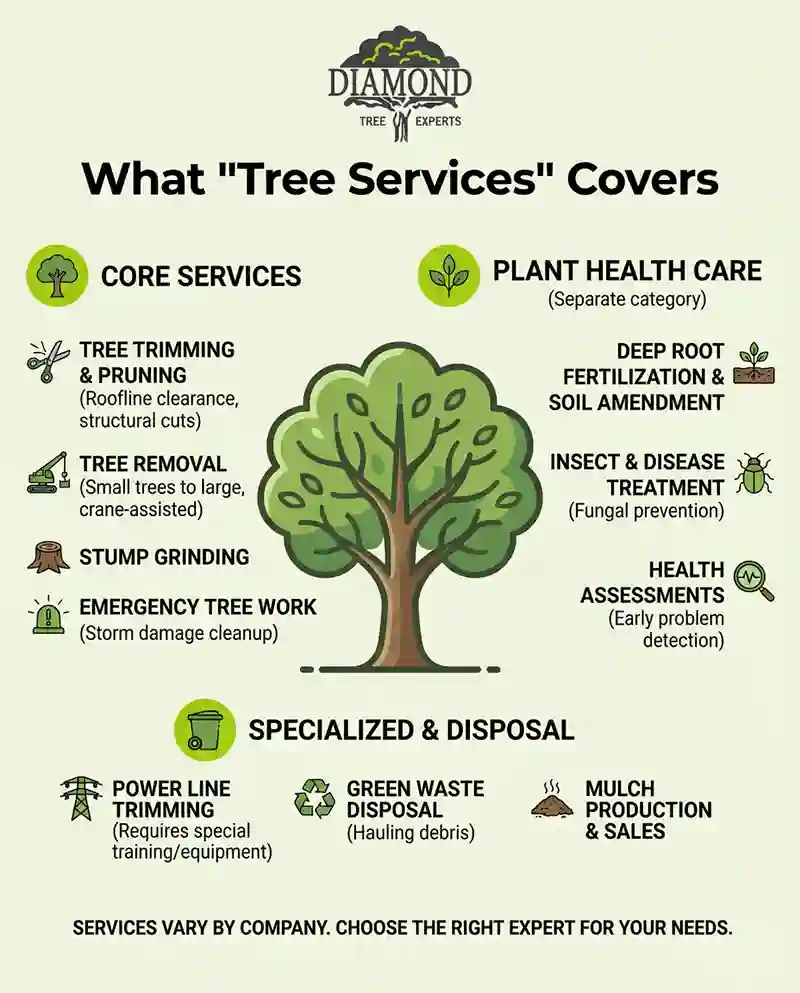
What “Tree Services” Covers
The term is broad, which is intentional. Tree services can mean trimming a few branches away from a roofline. It can mean removing a 90-foot cottonwood with a crane because there’s no other way to do it safely. It can mean treating a tree for a fungal disease before the infection spreads to adjacent trees on the same property.
The core services most companies offer include tree trimming and pruning, tree removal, stump grinding, emergency tree work after storm damage, and some form of plant health care. Plant health care is its own category. That includes things like deep root fertilization, soil amendment, insect and disease treatment, and health assessments that flag problems early.
Some companies also do power line trimming, which is a specialized category that requires different training and equipment than standard tree work. Green waste disposal, hauling the debris away after a job, is part of what full-service companies handle. A few also produce and sell mulch as a byproduct of what they chip on the job.
Not every company does all of this. Some focus on removal. Some focus on health care. Knowing what a specific company is actually equipped to handle matters when you’re trying to figure out who to call.
Get your free ESTIMATE
Give Us a Call: (801) 262-1596
Timing Tree Services in Utah
The general answer is late winter through early spring, roughly February through April depending on the year and the species. Trees are still dormant during that window. Pruning wounds have months of warm weather ahead of them to begin closing before the next cold season. The risk of fungal or bacterial infection entering through a fresh cut is lower than during active growth.
That said, there are real exceptions that are specific to Utah.
Elm trees should not be pruned between March and August. The elm bark beetle is active during that period, and fresh pruning cuts attract them. Elm trees that get pruned during the wrong window are at serious risk of Dutch elm disease spreading through the wound. The same logic applies to oaks and oak wilt. Pruning an oak in the middle of summer in Utah is the kind of mistake that can kill the tree, and it takes long enough to show up that people don’t always connect the cause to the outcome.
Fruit trees need annual pruning. Usually late winter before bud break. The reason is that fruit develops on one-year-old wood, so a significant portion of new growth needs to come off each year to keep production up and growth manageable.
Dead wood is different. It can be removed any time of year. Dead branches don’t respond to seasonal stress the way live tissue does, so dormancy doesn’t apply.
Tree removal works fine in winter, and sometimes it’s actually better. No foliage means cleaner sightlines for the crew. Frozen ground reduces equipment damage to surrounding lawn and landscaping. Winter is also off-peak, which usually means faster scheduling.
Emergency work obviously doesn’t follow a calendar. A tree that’s been pushed into a structure by wind or weighed down by wet snow needs to be dealt with as soon as it’s safe to work. Waiting on significant storm damage is not a reasonable option.
Why This Work Matters More Than Most People Think
Trees on a property are not static. They grow continuously, the structure changes, and problems develop over time whether anyone is paying attention or not. Included bark develops where two stems fork and grow too close together. Decay pockets form at old wound sites. Root systems expand and interact with irrigation lines, curbs, foundations, and neighboring root systems in ways that aren’t visible from the surface.
On residential properties, this mostly shows up as property damage when something fails. On commercial properties and HOA-managed communities, it shows up as liability. If a tree branch falls on a tenant’s vehicle, or on someone walking through a parking lot, the property owner’s responsibility for maintaining the trees in a reasonably safe condition is not a gray area. That responsibility exists regardless of whether anyone has looked at the tree recently.
Utah’s climate presses on trees in specific ways that are worth understanding. The soils across the Wasatch Front tend to run alkaline, which causes nutrient deficiencies in species that prefer lower pH. Summers are dry and hot, which stresses trees that aren’t irrigated adequately. Late spring snowstorms are a real hazard here. Wet, heavy snow loads onto canopies that are already leafed out, and structurally weak trees fail. It happens in the Salt Lake valley almost every few years. And the freeze-thaw cycles through winter crack bark and stress root tissue in ways that don’t show up until the following growing season.
Trees that are getting regular professional attention are better positioned to handle those pressures. Trees that aren’t tend to accumulate problems until something makes them visible, usually by failing.
Common Mistakes That Cause Real Damage
Topping is the one that causes the most long-term damage relative to how common it is. Topping means cutting the top off a tree, usually to reduce its height quickly or clear a view. The cuts are large and the wounds don’t close. Decay works in. The response is a flush of fast-growing, structurally weak regrowth that creates worse problems in a few years than the original tree had. A topped tree looks bad immediately and looks worse as the regrowth comes in. It also doesn’t reduce the long-term maintenance burden. It usually increases it.
Over-pruning is the next most common. Removing more than about 25 percent of a tree’s live canopy in a single session puts real stress on the tree. It can’t photosynthesize enough to heal wounds, resist pests, and sustain normal growth all at the same time. The tree survives but it’s in a weakened state, and weakened trees are more susceptible to insects and disease.
Cut placement matters and most homeowners don’t know it does. A cut made too close to the trunk removes the branch collar, which is the specialized tissue that allows the wound to compartmentalize and eventually close over. A cut made too far out leaves a dead stub that decays back toward the trunk. A proper pruning cut is just outside the branch collar, angled slightly to shed water. That’s what heals correctly.
The other significant mistake is ignoring early warning signs. Discolored or wilting foliage out of season. Premature leaf drop. Holes in the bark that suggest insect activity. Cankers. Fungal growth at the base of the trunk. None of these are cosmetic. They indicate that something is happening with the tree’s health or structural integrity. Early diagnosis by a certified arborist almost always leads to a less expensive outcome than waiting until the problem forces the issue.
What Deferred Maintenance Looks Like in Practice
Trees that don’t get pruned develop increasingly dense canopies. Reduced airflow and light penetration inside the canopy create conditions where fungal disease establishes. Crossing branches create contact wounds. Dead wood accumulates and can fall without warning. None of this happens fast. It happens gradually, which is part of why it gets ignored.
Storm events are when deferred maintenance becomes obvious all at once. A tree with co-dominant stems and no structural pruning history is significantly more likely to fail in high wind than one that has been maintained. Root rot that was never identified can take a standing tree to the ground in a single event. After the fact, the tree sometimes looks like it came down without warning. It usually didn’t. There were just no systems in place to catch what was developing.
On commercial properties and HOA communities, the pattern tends to be clear in post-storm assessments. Properties with regular maintenance programs have fewer emergency situations and lower overall tree care costs over time.
What to Look for When Hiring a Tree Service Company
ISA certification is the baseline credential. An ISA-certified arborist has passed accredited exams and completes continuing education to maintain the credential. It’s not a marketing term. It means the person has demonstrated knowledge of arboriculture at a professional level. Ask whether the company has certified arborists involved in assessing and overseeing the work, not just writing the estimate.
Licensing, insurance, and bonding are non-negotiable. Get proof before work starts. If a company can’t provide it, the risk from any incident during the job falls on the property owner.
Ask how they plan to approach the specific job. Large removals near structures, crane-assisted work, power line trimming, and technically difficult hazard tree work require equipment and experience that not every company has. A company that can explain their approach clearly has done it before.
Estimates should be based on actually looking at the property. A number quoted over the phone without a site visit is a guess, and it usually changes when the crew shows up and sees what the job actually involves.
About Diamond Tree Experts
Diamond Tree Experts has been providing professional tree services throughout Salt Lake, Utah, Davis, and Weber counties for over 57 years. The company has four ISA-certified arborists on staff with direct experience with the tree species, soil conditions, and climate pressures specific to the Wasatch Front.
Services include tree removal, tree trimming and pruning, stump grinding, emergency tree service, tree and plant health care, power line trimming, crane-assisted tree removal, green waste dumping, and mulch products. Diamond Tree Experts serves residential homeowners, commercial property managers, HOA boards, apartment property owners, and municipal clients across the region.
If you have a tree that concerns you, storm-damaged trees that need assessment, overdue maintenance, or you’re not sure what your property’s trees actually need, contact Diamond Tree Experts for a professional evaluation and free estimate.
No job is too small, no job is too large! We have 4 certified arborists on staff. Call the EXPERTS for all your Yard Care Needs, we have the experience and knowledge of over 50 years in business to back us up!
More Tree Services
- No Impact Tree Removals w/ the help of a crane.
- Drop Crotch Pruning
- Shrubbery Removals
- Shaping
- Deadwooding
- Reductions
- Safety Trimming
- Surface Roots
- Mowing
We service all of Salt Lake, Davis, Weber, Utah and Summit Counties.
Call us at (801) 262 1596, we are happy to serve you!
