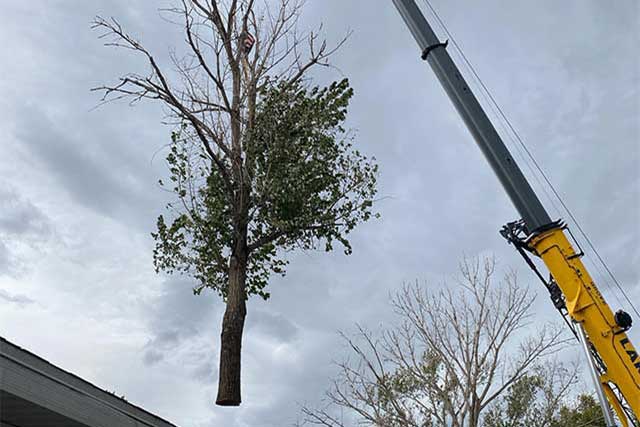
Crane Tree Removal

When a tree is too large, too damaged, or too close to your home, crane-assisted removal may be the safest way to take it down. Our crew removes large and hazardous trees throughout Salt Lake City and nearby areas.

If you have a tree over a roof, garage, fence, driveway, or tight backyard, we can inspect the situation and explain the safest removal option.

When Does Tree Removal Require a Crane?

Most trees do not need one. Even a big, old tree in a sloped backyard may come down just fine with a climber and a rope system. Size alone is not what drives the decision.

What actually forces the crane call is the space around the tree. Where the sections have to go once they are cut. Whether there is room to work, room to lower, room to land wood without it hitting something valuable.

A dead elm sitting over a detached garage with a fence on one side and a neighbor’s property on the other — that tree almost certainly needs a crane. Not because it is huge, but because there is nowhere for the sections to go except through or onto something.

Dead wood is its own problem. When a tree dies and starts drying out, the wood gets unpredictable. It does not fail the way green wood fails. Sections can break partway through a cut, splinter in unexpected directions, or crack under rigging load in a spot you did not anticipate. That unpredictability is part of why dead trees near structures push toward crane removal even when they are not enormous.

Storm damage is the other thing people underestimate. A tree that got hit by wind or ice and is still upright is not necessarily stable. The root plate may have shifted. The trunk may have a crack that is not obvious until someone gets close. Trees that look like they survived a storm sometimes did not, not structurally.

A leaning tree is a loaded question. Some lean is fine and has been there for years. A lean that developed after a storm, or a lean toward a structure with no good rigging anchor on the other side, is a different situation entirely.

Get your free ESTIMATE

Contact Us

Give Us a Call:  (801) 262-1596

Tree Removal Over Homes, Garages, Fences, and Tight Spaces

The crane lifts sections straight up, the operator swings the boom over the structure, and the section gets lowered into a staging area. Clean, controlled, nothing dragging across a roof or swinging into a gutter.

That matters because standard rigging on tight jobs relies on friction and redirect pulleys to slow and guide sections as they come down. When the section is very heavy or the path to the ground is very tight, those systems can fail or the section can contact the structure on the way down. Happens more than people think.

Salt Lake City residential lots, especially in older neighborhoods, were not designed with 60-foot tree removal in mind. Sugar House, Millcreek, Holladay, and similar areas have mature trees in yards that have gotten more built-up around them over the decades. That combination, big trees and limited space, is exactly what crane removal is for.

Crane Tree Removal Cost in Salt Lake City

Crane tree removal costs more than standard removal. That is just true. The crane itself typically runs $150 to $300 per hour to operate, and that is before the crew, the setup, the cutting, or the cleanup.

Total job costs in Salt Lake City for crane-assisted removals generally range from $1,500 on the low end for a smaller, straightforward job to $5,000 or more for large trees with complex access situations. Emergency tree work adds cost on top of that.

What actually drives the price: how large the tree is, how many crane lifts the job requires, how close the crane can get to the tree, how much coordination is needed around structures, and whether stump grinding is required, debris is being hauled or left for chipping on site.

No one can give an accurate price without seeing the job. A phone quote for crane removal is a guess. Sometimes an informed guess, but still a guess.

Emergency Crane Tree Removal

A tree that has fallen onto a structure is under load and tension. It is not just a tree lying on a roof. The weight is distributed in ways that are not obvious from the outside, and cuts made in the wrong sequence can cause the tree to shift suddenly and cause more damage or injure someone nearby.

Do not try to cut it yourself. Seriously applies here in a practical, not cautionary, sense. A chainsaw cut on a tree under compression releases that energy. If you do not know which direction the tree will move when that happens, you should not be making the cut.

Call first. Let the crew assess where the load is before anything gets cut.

If the tree is near or on power lines, the utility company gets called before the tree crew starts work. That is not optional and a reputable company will not skip that step regardless of how urgent the situation feels.

Hazardous Tree Removal with Crane Support

A hazardous tree is not always dramatic about it. Some of the most dangerous trees in Salt Lake City look fine from the street.

Internal decay is common in older trees and does not show on the outside until the tree is well past the point where intervention was easy. Ganoderma fungus at the base, conks growing from the trunk, or carpenter ant activity in the heartwood are signs that the structural integrity of the wood is compromised in ways a visual inspection from the ground will miss.

Sudden lean is a red flag regardless of tree species. If a tree that was plumb six months ago now has a visible lean and you can see soil movement or root heave at the base, that root plate has shifted. That tree is not stable.

Climbing an unstable tree to rig it for removal puts the climber in a genuinely bad situation. A crane changes that by allowing sections to be worked from outside the tree rather than from inside the canopy. The crew can take the top out in sections using the crane for extraction without a climber ever being in the highest, most unstable part of the tree.

Our Services

large tree removal

Tree Removal

tree trimming

Tree Trimming

stump grinding

Stump Grinding

mulch

Mulch Products

green waste dumping

Green Waste Dumping

demolition

Demolition

Crane Removal vs. Regular Tree Removal

Standard removal, cut and lower in sections using a climber and a rope system, is faster and cheaper when conditions allow for it. Most tree removals fall into this category.

Crane removal is slower, more expensive, and requires more setup. It is also the right call when the alternative is accepting a meaningful risk of property damage or crew injury to avoid the cost.

The mistake some homeowners make is pressuring a crew to do a job the standard way when the job actually calls for a crane, because crane removal costs more and that feels like an upsell. Sometimes it is. But sometimes the crew recommending it is telling you something accurate about the risk involved, and pushing back on that to save money is a decision with real consequences.

A tree section that swings into a roof on the way down is going to cost more than the crane rental would have.

Our Crane Tree Removal Process

It starts with an on-site assessment. The crew looks at the tree height, trunk diameter, crown spread, lean direction, wood condition, and the access situation for the crane. Access matters more than people expect. A crane needs a stable position to operate from, and if the only spot available is a soft lawn or a narrow driveway, that affects the setup.

Once the plan is set, the crew rigs from the top down. Each section is secured with a choker or sling before the cut is made. The crane holds the load, the cut is made, and the section is flown to the staging area. That sequence repeats until the trunk is at stump height.

Stump grinding is a separate service. Debris handling depends on what was agreed in the estimate. Some jobs leave chips and rounds for the homeowner, some include full haul-off.

Licensed, Insured, and Experienced Crane Tree Removal

Two things to ask for before any crew starts work on a crane removal job: a certificate of general liability insurance and proof of workers compensation coverage. Not a verbal confirmation. The actual certificate, showing the policy is current.

A crane removal over a structure without liability coverage means that if something goes wrong, the property owner is dealing with the damage out of pocket. That happens. Unlicensed or underinsured tree companies are not rare, and crane jobs are exactly where that gap in coverage becomes expensive.

Experience is worth asking about too. Crane tree removal is not just regular tree removal with a crane attached. The rigging is different, the sequencing matters more, and the communication between the climber, the ground crew, and the crane operator has to be precise. A crew that does this regularly handles that coordination differently than a crew that rents a crane occasionally.

Diamond Tree Experts is licensed and insured, and has been doing complex tree removals in Salt Lake City for decades.

Residential Crane Tree Removal

Most of the crane removal calls Diamond Tree Experts gets in Salt Lake City are from homeowners who have a large tree near the house that either died, got damaged in a storm, or has grown to the point where it is overhanging the roof in a way that is no longer manageable.

Crane access on residential lots usually works off the street or driveway. Side yards narrow enough that the crane cannot set up close to the tree will change the lift radius required, which affects the equipment needed. All of that gets figured out during the assessment before a price is given.

If you have a tree that is worrying you, the first step is having someone look at it. Not every tree near a house needs a crane to come down. Some do. You will not know which situation you are in without an inspection.

Commercial, HOA, and Property Management Crane Tree Removal

Commercial jobs have different scheduling constraints than residential ones. A parking lot that has to stay partially accessible, a building with tenants who need to get in and out, a school where the work has to happen outside of operating hours. All of that factors into how the job is planned.

Documentation matters more on commercial work too. HOAs often need written estimates before approving work. Property managers need invoices for their records. Insurance claims require photos and documentation of the scope of work. Diamond Tree Experts can provide all of that.

The tree removal itself is not different from residential work. The logistics around it are.

Large Tree Removal in Salt Lake City

Salt Lake City has a lot of old, large trees. Siberian elms that were planted as windbreaks and shade trees in the mid-20th century are now enormous. Cottonwoods along irrigation corridors have trunks you cannot put your arms around. Silver maples planted near houses 40 years ago are now well past the size they were planted to be.

Large does not automatically mean a crane is required. But large trees near structures, or large trees with compromised wood, usually do. The sections are too heavy to manage by rope alone in a confined space, and the consequences of something going wrong are proportionally larger.

If a tree on your property is large enough that you are not sure how to take it down without risking the structures around it, that is the right time to call.
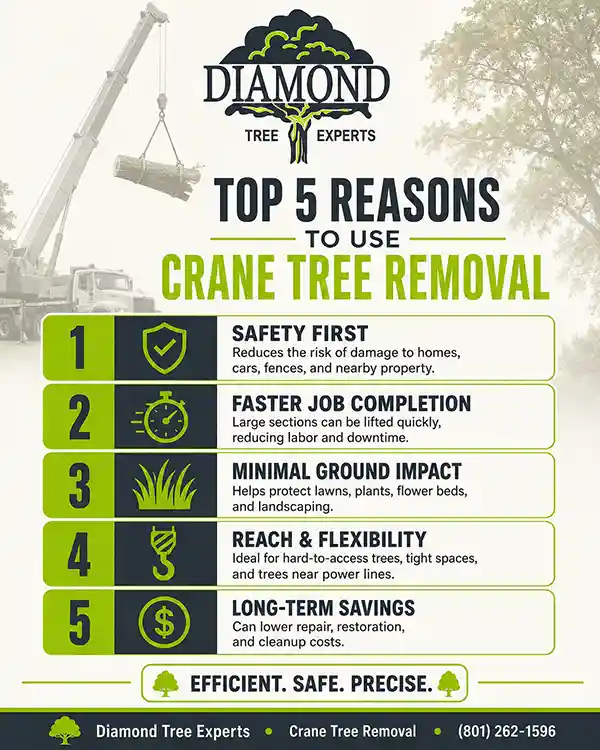
top 5 reasons for crane removal

Service Areas Around Salt Lake City

Diamond Tree Experts provides crane tree removal in Salt Lake City and nearby communities including South Salt Lake, Millcreek, Sugar House, Holladay, Murray, Taylorsville, West Valley City, West Jordan, Sandy, Ogden, Draper, Riverton, Cottonwood Heights, Magna, and other Salt Lake County areas.

Not sure if your location is covered, call and ask. www.diamondtreeexperts.com

Crane Tree Removal FAQs

How do I know if my tree needs a crane?

If there is no safe place to lower sections without risking damage to structures or people nearby, a crane is probably the right tool. Tree size is part of the equation but not all of it. Location, access, and wood condition all factor in. An on-site look is the only way to know for certain.

Is crane tree removal safer?

On jobs where conditions call for it, yes. It eliminates or reduces the rope work through tight spaces that is most likely to result in damage. It also keeps the crew out of the canopy on trees that are too unstable to climb safely.

How much does crane tree removal cost?

There is no honest flat-rate answer. Crane rental, crew size, job complexity, access, and cleanup all affect the price. Get an on-site estimate.

Can you remove a tree over my house?

Yes, in most cases. That is one of the primary situations crane removal addresses.

Do you offer emergency crane tree removal?

Call as soon as the situation develops. Emergency availability depends on schedule and crane access. The sooner you call, the more options there are.

Does insurance cover crane tree removal?

Depends on the policy and what caused the situation. If a tree fell on a covered structure, your insurer may cover some or all of the removal. They will need documentation. We provide estimates and invoices.  Contact your insurance agent to see what they will cover for crane tree removal.

Our Service Area

salt lake city

Salt Lake City

draper

Draper

sandy

Sandy

ogden utah

Ogden

layton

Layton

riverton

Riverton